
Best Android Phones With eSIM Support in 2026
Google Pixel and Samsung Galaxy S/Z-series phones carry the most consistent native eSIM support on Android in 2026, but carrier locks, regional hardware variants and single-profile switching still catch buyers off guard. Here's the ranked breakdown, the verified limitations, and what to buy when your Android phone falls short.
Best overall for native eSIM: Google Pixel series. Best for dual-eSIM without a physical SIM tray: Samsung Galaxy Z Fold and Z Flip. Best budget Android eSIM phone: Motorola Edge series. Best for regions with inconsistent eSIM rollout: OnePlus. Best fallback when your Android phone lacks reliable eSIM: the Switch Pro adapter.
- Google Pixel phones have supported native eSIM since the Pixel 3 in 2018 and remain the most consistent Android option in 2026.
- US carrier variants of the Galaxy Z Fold and Z Flip ship eSIM-only, no physical SIM tray, since 2023.
- Carrier lock status blocks eSIM activation on eSIM-capable Android hardware more often than the hardware itself does.
- Switch Pro adds up to 15 storable eSIM profiles to any compatible Android phone with a physical SIM slot, native support or not.
Why this matters
Native eSIM on Android is not a single standard you can assume across a brand. It's a hardware certification plus a software flag the carrier controls, and both vary by model, region and lock status.
Buy the wrong variant and you get a phone with eSIM-capable silicon and a carrier that has switched the feature off. That's the single most common complaint in Android eSIM buying threads, and it has nothing to do with the phone's specs sheet.
A Switch Pro eSIM adapter sidesteps that problem entirely by working through the phone's physical SIM slot instead of the carrier's software flag, which matters if you're stuck with a locked or eSIM-disabled unit.
What makes the best Android phone for eSIM
- GSMA RSP certification — the phone's modem must be certified for Remote SIM Provisioning, not just marketed with an eSIM logo.
- Carrier-unlocked variant availability — many US carrier models physically ship with eSIM disabled at the firmware level.
- Confirmed regional variant — a phone sold in the EU with eSIM does not guarantee the same SKU in the US or Asia behaves the same way.
- Simultaneous eSIM + physical SIM, or dual-eSIM — some models activate only one line at a time regardless of how many profiles are stored.
- Profile switching without a factory reset — cheaper Android implementations still require a full data wipe to swap carriers.
- Update cadence for eSIM firmware — Android OEMs patch RSP bugs at very different speeds.
Android phones with eSIM, at a glance
| Phone family | Best for | Standout feature | Key limitation |
|---|---|---|---|
| Google Pixel series | Carrier compatibility | Native eSIM since 2018, broadest carrier list | Storage-tier variants sold in some markets skip eSIM |
| Samsung Galaxy S series | Mainstream US/EU carriers | eSIM since the Galaxy S20 in 2020 | Some US carrier bundles ship locked with eSIM disabled |
| Samsung Galaxy Z Fold/Flip | Dual-eSIM, no SIM tray | US models eSIM-only since 2023 | No physical SIM fallback if eSIM activation fails |
| Motorola Edge/Razr | Budget eSIM Android | Lower cost entry into native eSIM | Support inconsistent across regional SKUs |
| OnePlus | Inconsistent-rollout regions | eSIM on select flagship models | Many EU and India units still ship eSIM-less |
1. Google Pixel series: best Android phone with eSIM for carrier compatibility
Google built native eSIM support into the Pixel line starting with the Pixel 3 in 2018, and it has stayed a first-party feature every generation since. Pixel phones carry the widest carrier acceptance list of any Android device on the market in 2026.
Google Pixel pros:
- Longest track record of native Android eSIM, dating to 2018
- Direct QR-code and carrier-app activation with minimal setup friction
- Broadest published carrier compatibility list among Android OEMs
Google Pixel cons:
- Storage-tier variants in a handful of markets still ship without eSIM
- Carrier-branded units sold through some US retailers can arrive locked
Best for: buyers who want the most tested native eSIM implementation on Android. Verdict: Buy — confirm the exact storage variant and carrier lock status before ordering.
2. Samsung Galaxy S series: best for mainstream US and EU carriers
Samsung added eSIM to the Galaxy S line with the Galaxy S20 in 2020, and every S-series flagship since has carried it. Coverage across major US and EU carriers is now standard, though unlocked-vs-carrier variants still diverge.
Samsung Galaxy S pros:
- eSIM on every S-series model since the Galaxy S20 (2020)
- Wide carrier support across North America and Europe
- Dual-SIM (eSIM + physical) on most unlocked units
Samsung Galaxy S cons:
- Some US carrier-branded units ship with eSIM disabled by the carrier
- Import units may not match the eSIM behavior of the regional retail SKU
Best for: shoppers on major US or EU carriers who want an unlocked variant. Verdict: Buy — buy unlocked, not carrier-branded, if eSIM matters.
3. Samsung Galaxy Z Fold and Z Flip: best for dual-eSIM without a SIM tray
US carrier models of the Galaxy Z Fold and Z Flip have shipped eSIM-only, with no physical SIM tray, since 2023. That makes the line the clearest Android example of eSIM as the primary connectivity method rather than a backup.
Galaxy Z Fold/Flip pros:
- Dual-eSIM support without needing a physical SIM at all
- Compact form factor with full eSIM feature parity to the S series
- No tray means no lost SIM ejector tool
Galaxy Z Fold/Flip cons:
- No physical SIM fallback if an eSIM activation fails mid-trip
- International variants outside the US may still include a tray, so specs are not interchangeable
Best for: buyers who want a phone built around eSIM as the default, not the exception. Verdict: Buy — check whether your specific regional unit has a tray or not before assuming behavior.
4. Motorola Edge and Razr: best budget Android eSIM option
Motorola has extended eSIM to select Edge and Razr models at lower price points than Google or Samsung's flagships, though support is less consistent across regional SKUs than either.
Motorola Edge/Razr pros:
- Lower entry cost into native Android eSIM
- Razr foldables carry eSIM support in several markets
Motorola Edge/Razr cons:
- Not every Edge or Razr variant includes eSIM — model number matters
- Carrier compatibility lists are shorter and less documented than Pixel or Galaxy
Best for: buyers who want eSIM without flagship pricing and are willing to verify the exact model number. Verdict: Hold — confirm eSIM on your specific SKU before purchase, not the product line in general.
5. OnePlus: best for regions with inconsistent eSIM rollout
OnePlus has added eSIM to select flagship models, but rollout has been uneven across Europe, India and North America, with several recent phones shipping eSIM-less in specific markets.
OnePlus pros:
- Flagship-tier hardware at competitive pricing where eSIM is present
- Fast software updates once a model does support eSIM
OnePlus cons:
- Many EU and India units still ship without eSIM entirely
- No consistent naming pattern to tell eSIM and non-eSIM variants apart at a glance
Best for: OnePlus loyalists who confirm eSIM support model-by-model before buying. Verdict: Wait — verify the exact regional listing; don't assume the flagship spec sheet applies to your market.
How we ranked these
Each phone family is scored against the six criteria above: RSP certification, unlocked-variant availability, confirmed regional behavior, simultaneous-line support, reset-free switching and update cadence. Pixel and Galaxy S lead because Google and Samsung publish the most consistent eSIM documentation across regions; Motorola and OnePlus drop because their eSIM support still depends heavily on the exact model number, not just the product line.
When native eSIM isn't enough
Even a certified eSIM phone runs into three real limits: it typically activates one or two lines at a time, switching carriers often means digging through settings menus, and a carrier lock can disable the feature regardless of hardware. None of that is a Switch eSIM claim — it's how RSP works on stock Android.
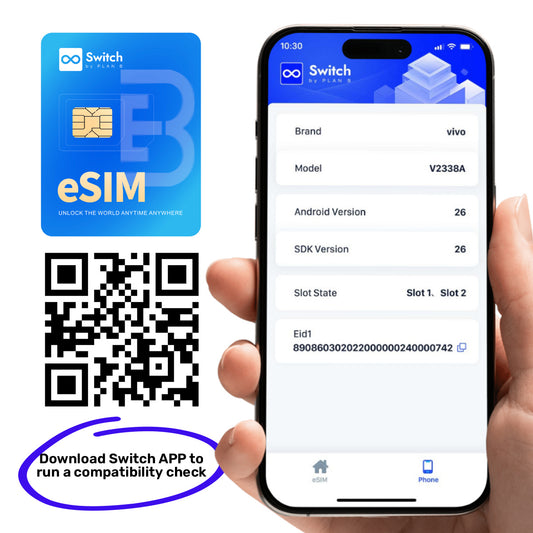
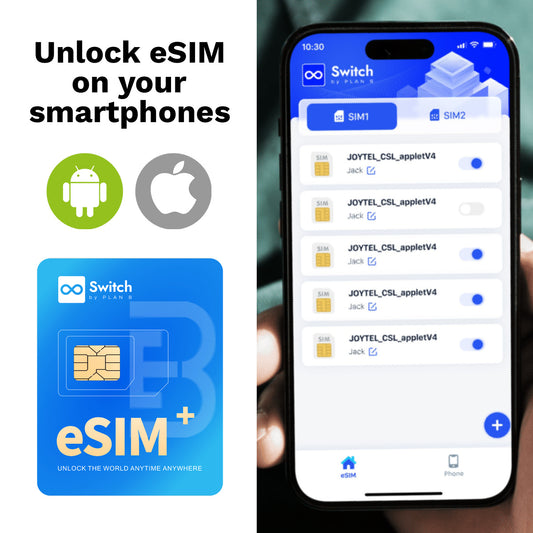
A physical eSIM adapter routes around all three. Switch Pro is a SIM-sized card for Android phones with a compatible physical SIM slot; it stores up to 15 eSIM profiles and switches between them through the Switch Android app, independent of what the phone's native eSIM menu allows. It requires a working physical SIM tray — it does not work on eSIM-only Fold or Flip variants that removed the tray entirely.
For mixed Android and iPhone households, Switch Max extends the same 15-profile card to compatible iPhone models alongside Android, so one card format covers both platforms — again, only on phones that still carry a physical SIM slot.
If you'd rather not touch a phone's settings menu at all, the Bluetooth eSIM card reader bundle pairs a Switch card with a standalone Bluetooth reader that loads and manages profiles directly, no Android app step required.


Which Android phone should you choose?
If you're buying new in 2026 and want the least friction, buy an unlocked Google Pixel — the longest and most consistent native eSIM record on Android. If you already own a phone with a locked or eSIM-disabled carrier variant, a Switch Pro adapter fixes that without a new phone purchase, provided the phone still has a physical SIM slot. If you're on a Galaxy Z Fold or Flip US model with no tray at all, native eSIM is your only path — there's no adapter workaround for a phone with no physical SIM slot.
FAQ
What is the best Android phone for eSIM in 2026?
Google Pixel phones remain the most consistent choice in 2026, with native eSIM support dating back to the Pixel 3 in 2018 and the broadest published carrier list of any Android line. Samsung Galaxy S series (eSIM since 2020) is a close second on mainstream carriers.
Do all Android phones support eSIM?
No. Native eSIM support depends on the exact model, regional variant and carrier lock status, not just the brand. A US carrier-branded unit can ship with eSIM hardware present but disabled in firmware.
Are Samsung Galaxy Z Fold and Z Flip eSIM-only?
US carrier models of the Galaxy Z Fold and Z Flip have shipped without a physical SIM tray since 2023, making them eSIM-only in that market. International variants may still include a tray, so check the specific regional SKU.
How many eSIM profiles can a native Android phone store?
Native Android eSIM implementations vary by OEM and typically activate one or two lines at a time even when several profiles are stored. A Switch Pro or Switch Max adapter stores up to 15 profiles independent of the phone's native limit.
What if my Android phone doesn't support eSIM at all?
A physical eSIM adapter like Switch Pro fits into a standard SIM slot and adds eSIM profile switching to phones without native support, as long as the phone has a working physical SIM tray. It won't help on tray-less phones.
Is OnePlus reliable for eSIM support?
Inconsistently. OnePlus has added eSIM to select flagship models, but many units sold in Europe and India still ship without it, so the exact regional listing needs checking before purchase.
What's the difference between Switch Pro and Switch Max?
Switch Pro manages eSIM profiles through the Switch Android app for compatible Android phones. Switch Max extends the same card format to compatible iPhones as well as Android, both requiring a physical SIM slot.
Can a carrier-locked Android phone use eSIM?
Carrier lock status blocks eSIM activation more often than the hardware itself does, even on phones certified for eSIM. Confirm unlock status before assuming eSIM will work.
One last thing
Most buyers assume an eSIM problem is a hardware problem. In 2026, it's more often a firmware flag the carrier switched off on an otherwise eSIM-capable phone — check unlock status before you check the spec sheet.