
Best Budget Phones With eSIM Support in 2026
Best overall: Google Pixel 8a. Best budget iPhone: iPhone SE (2022). Best for Samsung's ecosystem: Samsung Galaxy A55. Best cheaper alternative: Google Pixel 7a. Best for clean software, with one big caveat: Nothing Phone 2a. None of these fix the actual limit: most budget phones with eSIM support in 2026 cap you at one active profile, and the phone itself decides how many eSIMs you can even store.
- Google Pixel 8a is the strongest overall pick among budget phones with esim support in 2026 for native dual-SIM handling.
- iPhone SE (2022) is the only current budget iPhone pairing a physical SIM tray with eSIM in every market including the US.
- Nothing Phone 2a supports eSIM inconsistently by region and carrier variant, confirm before buying.
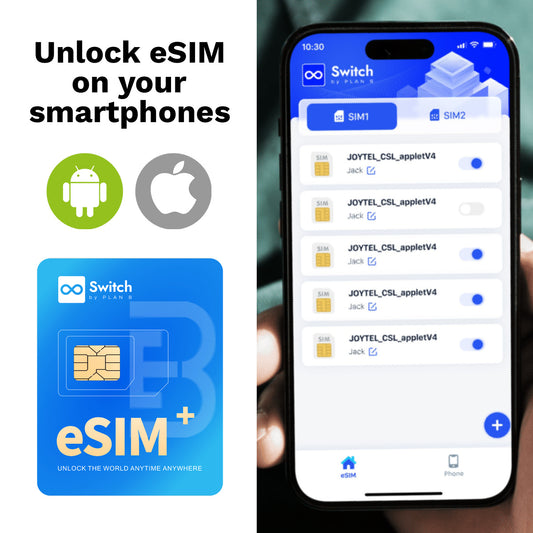
- A Switch Pro or Switch Max card adds up to 15 stored eSIM profiles on a phone with a free physical SIM slot.
- Native eSIM on a budget phone rarely means unlimited profiles, the physical SIM slot is the workaround, not a downgrade.
Why this matters
Every phone maker markets "eSIM support" as one feature, but it hides three separate questions: does the phone store more than one profile, can it run two profiles active at once, and does it keep a physical SIM tray for backup. Budget phones with eSIM support in 2026 answer these three questions differently model to model, and the answer decides whether you can also run a Switch Pro or Switch Max card later for extra profile storage.
Get the phone wrong and you're stuck swapping eSIM profiles through carrier apps and QR codes every time you cross a border. Get it right, and you keep a physical SIM slot open for a card that holds far more profiles than the phone does natively. A dedicated guide to budget Android phones with eSIM covers the Android side in more depth if that's your platform.
What makes the best budget phone with eSIM support
- Physical SIM slot alongside eSIM — needed for dual-SIM use now and for adding a Switch card later
- Confirmed activation method — QR-code activation is more consistent across regions than app-based provisioning
- Native profile handling — dual SIM dual standby (both active) beats a single-active-eSIM design
- OS update commitment — longer software support keeps eSIM management stable over the phone's life
- Carrier-lock status of the specific unit — a locked phone can restrict eSIM profile switching regardless of hardware
Budget phones with eSIM support in 2026, at a glance
| Phone | Best for | Standout eSIM feature | Key limitation |
|---|---|---|---|
| Google Pixel 8a | Native eSIM + physical SIM combo | Dual SIM dual standby, physical + eSIM both active | Fewer stored profiles than a dedicated adapter card |
| Google Pixel 7a | Lower-cost Pixel eSIM option | Same dual-standby handling as the 8a | Shorter remaining OS update window |
| iPhone SE (2022) | iPhone users who need a SIM tray | Physical nano-SIM tray + eSIM in every market, including the US | Only one eSIM active alongside the physical SIM at a time |
| Samsung Galaxy A55 | Samsung ecosystem, Switch card compatibility | Physical SIM slot free for a Switch Pro or Switch Max card | Tray layout (dual nano-SIM vs hybrid) varies by region |
| Nothing Phone 2a | Clean software on a budget | Near-stock Android, fast security patches | eSIM support has varied by region and carrier variant |
1. Google Pixel 8a: best budget phone with eSIM support overall
The Pixel 8a runs stock Android with a physical nano-SIM tray and native eSIM, and it can keep both active at once in dual SIM dual standby mode.
Google Pixel 8a pros:
- Physical SIM tray plus eSIM active simultaneously
- Stock Android with predictable security patch cadence
- QR-code eSIM activation works consistently across most carriers
Google Pixel 8a cons:
- Native eSIM storage on the phone is limited compared to a dedicated card
- Some regional carrier variants restrict activation to their own app instead of a QR code
Best for: buyers who want the most reliable native eSIM plus physical SIM slot combo in the budget tier. Verdict: Buy.
2. Google Pixel 7a: best cheaper Pixel with eSIM
The 7a carries the same dual SIM dual standby eSIM behavior as the 8a in an older, cheaper chassis.
Google Pixel 7a pros:
- Same simultaneous physical SIM + eSIM handling as the 8a
- Proven track record on eSIM activation across major carriers
- Compact size some buyers prefer over the 8a
Google Pixel 7a cons:
- Shorter remaining stretch of OS and security updates than the 8a
- Lower base storage tier
Best for: buyers who want Pixel's eSIM handling without paying for the newest model. Verdict: Buy if it costs less than the 8a where you're shopping.
3. iPhone SE (2022): best budget iPhone with eSIM support
The iPhone SE (2022, 3rd generation) is the last current budget iPhone that keeps a physical nano-SIM tray in every market, including the US, alongside eSIM support.
iPhone SE (2022) pros:
- Physical SIM tray present globally, unlike newer US iPhone models
- Compatible with a configured Switch Max card for extra profile storage on iOS
- Smallest, cheapest current iPhone with eSIM
iPhone SE (2022) cons:
- Only one eSIM can run active alongside the physical SIM at a time
- Camera and display hardware trail current flagship iPhones
Best for: iPhone users who specifically need a physical SIM tray to remain available. Verdict: Buy.
4. Samsung Galaxy A55: best for Samsung users who want a Switch-ready SIM slot
The Galaxy A55 pairs a physical SIM slot with native eSIM, but the exact tray layout differs by region — some units run dual nano-SIM, others a hybrid slot that trades the second SIM for microSD storage.
Samsung Galaxy A55 pros:
- Physical SIM slot free for a Switch Pro or Switch Max card once configured
- Samsung Knox security stack carried down from flagship models
- Solid battery life for the price tier
Samsung Galaxy A55 cons:
- Dual nano-SIM vs hybrid tray configuration varies by regional variant, confirm before buying
- Carrier-locked units may restrict eSIM profile switching independent of the hardware
Best for: Samsung buyers who want to keep a physical SIM slot open for a Switch card. Verdict: Buy, after confirming your unit's tray layout.
5. Nothing Phone 2a: best clean-software budget pick, with a real caveat
The Nothing Phone 2a runs close to stock Android with fast patch delivery, but eSIM support on Nothing devices has historically varied by region and carrier variant — this is a documented limitation, not a rumor.
Nothing Phone 2a pros:
- Near-stock Android interface with quick security updates
- Competitive hardware for the price tier
- Physical SIM slot present on the chassis
Nothing Phone 2a cons:
- eSIM availability has not been consistent across every regional launch
- Smaller list of verified carrier compatibility than Pixel or Samsung
Best for: buyers who prioritize software cleanliness and are willing to verify eSIM support for their exact regional unit first. Verdict: Hold until you confirm eSIM works on your specific variant.
When native eSIM capacity isn't enough
None of the five phones above store more than a handful of eSIM profiles natively, and most only run one active at a time. A physical SIM slot — the same slot carriers use — is what a Switch Pro or Switch Max card needs to work. Switch Pro is built for compatible Android phones with a free SIM slot and manages profiles through the Switch Android app; Switch Max extends that same card format to compatible iPhones, including the iPhone SE (2022), when configured for iOS.
Both cards hold up to 15 eSIM profiles at once on the card itself, well past what any phone on this list manages natively. Neither works without a physical SIM slot on the target device, and neither claims compatibility with "any phone" — model, regional variant, carrier-lock status and network bands still decide fit. For provisioning profiles without going through a phone at all, the Open Source Bluetooth eSIM Card Reader loads profiles onto a Switch card directly.


“A budget phone's SIM tray is not a downgrade from eSIM, it is the slot that turns a one-profile limit into fifteen with a Switch card.”
How we ranked these phones
Each phone on this list was checked against the five criteria above: physical SIM slot presence, activation consistency, active-profile handling, update commitment, and carrier-lock exposure. The Pixel 8a wins overall because it clears all five without regional asterisks. The A55 and Nothing Phone 2a drop lower specifically because their SIM tray layout and eSIM rollout, respectively, vary by market.
Which budget phone with eSIM support should you choose in 2026?
Pick the Google Pixel 8a if you want the safest native eSIM plus physical SIM combo with no regional guesswork. Choose the iPhone SE (2022) if you're staying in iOS and need that physical tray preserved. Go with the Samsung Galaxy A55 if you're already in Samsung's ecosystem and plan to add a Switch card down the line — just confirm your unit's tray layout first. Skip the Nothing Phone 2a until you've verified eSIM works on your exact regional variant.
FAQ
What's the best budget phone with eSIM support in 2026?
The Google Pixel 8a is the strongest overall pick in 2026 because it runs a physical SIM and eSIM active at the same time with consistent QR-code activation across carriers. The iPhone SE (2022) is the top choice for iPhone users who need a physical SIM tray.
Is the iPhone SE (2022) a good budget eSIM phone?
Yes, it is the only current budget iPhone that keeps a physical nano-SIM tray in every market, including the US, alongside eSIM. It only runs one eSIM active alongside the physical SIM at a time.
Do budget Android phones support dual eSIM?
Some do and some don't; the Pixel 8a and 7a support dual SIM dual standby with a physical SIM and an active eSIM together, but many budget Android phones limit you to one active profile at a time. Check the specific model before assuming dual-active support.
Can I add eSIM capability to a phone that doesn't support it natively?
No, a phone without native eSIM hardware cannot gain eSIM support through an external card. A Switch Pro or Switch Max card instead adds extra eSIM profile storage on a phone that already has a physical SIM slot.
How many eSIM profiles can I store compared to a Switch card?
Budget phones on this list store far fewer eSIM profiles natively than a dedicated card. A Switch Pro or Switch Max card holds up to 15 eSIM profiles at once, well beyond what any phone here manages on its own.
Does the Nothing Phone 2a support eSIM in every region?
No, eSIM support on Nothing devices has varied by region and carrier variant historically. Confirm eSIM availability for your exact regional unit before buying it for that reason.
What's the difference between Switch Pro and Switch Max?
Switch Pro manages eSIM profiles through the Switch Android app on compatible Android phones with a free SIM slot. Switch Max extends that same card format to compatible iPhones, including models like the iPhone SE (2022), once configured for iOS.
Does a physical SIM slot still matter if my phone already has eSIM?
Yes, the physical SIM slot is what a Switch Pro or Switch Max card uses to add extra stored eSIM profiles beyond what the phone manages natively. Losing that slot on newer eSIM-only phones removes the option entirely.
One last thing
The feature most buyers overlook when shopping budget phones with eSIM support in 2026 is the one that costs nothing extra: a free physical SIM slot. It's worth more long-term than an extra gigabyte of RAM, because it's the difference between being stuck at your phone's native eSIM limit and running up to 15 profiles off a Switch Pro or Switch Max card instead.