
Best Unlocked Phones With eSIM Support in 2026: Ranked
The Apple iPhone 16 (international, non-US unlocked model) is the best unlocked phone with eSIM support in 2026 for native dual-eSIM switching. The Samsung Galaxy S24 unlocked wins for buyers who want a physical SIM slot next to eSIM. And any unlocked phone with a free SIM slot paired with a Switch Pro or Switch Max card wins once a phone's built-in eSIM limit stops being enough.
- Apple iPhone 16 international models lead unlocked phones with eSIM support for native dual-eSIM switching in 2026.
- Samsung Galaxy S24 unlocked pairs a physical SIM slot with eSIM, but enablement depends on the exact regional variant.
- US retail iPhones since the iPhone 14 generation ship with no physical SIM tray at all — eSIM-only, no adapter workaround possible.
- Switch Pro and Switch Max store up to 15 eSIM profiles on one card for phones that outgrow native limits.
- Carrier-locked units can block eSIM from a second provider regardless of what the phone's spec sheet lists.
Why this matters
An unlocked phone with eSIM support only helps if the eSIM actually activates on your carrier in your region's firmware build. Buying on the spec sheet alone is the biggest mistake shoppers make in 2026 — a phone can list "eSIM support" and still ship carrier-locked in a way that blocks any profile except the original network's.
Native eSIM capacity is also smaller than most buyers assume. Most Android phones hold one active eSIM profile at a time even when several are stored; the iPhone activates two profiles at once but adds no more locally without deleting an older one. That's fine for a single traveler adding one extra line. It's not fine for anyone juggling a home line, a work line and a travel line every month — which is where a Switch eSIM Adapter Pro or Switch Max earns its place, holding up to 15 profiles on a card that swaps into the same SIM slot.
What makes the best unlocked phone with eSIM support
- Confirmed eSIM activation on your carrier — not just listed hardware support
- Carrier-lock status — a locked unit can block competing eSIM profiles outright
- Physical SIM slot presence — needed if you ever want to add an adapter later
- Simultaneous active-profile count — one active eSIM on most Android phones versus two on most iPhones
- Regional variant and firmware build — the same model number can behave differently by market
- Native eSIM profile storage limit — how many profiles the phone keeps before forcing a delete-and-reinstall
Unlocked phones with eSIM support, at a glance
| Phone | Best for | Standout eSIM feature | Key limitation |
|---|---|---|---|
| Apple iPhone 16 (international) | Native dual-eSIM travel switching | Two active eSIM profiles at once | US retail units ship with no SIM tray at all |
| Samsung Galaxy S24 (global unlocked) | Physical SIM + eSIM flexibility | Nano-SIM slot runs alongside eSIM | Enablement varies by carrier-locked variant |
| Google Pixel 9 (unlocked) | Stock Android eSIM setup simplicity | Simplest native eSIM add/switch flow on Android | Only one active profile at a time on most builds |
| Samsung Galaxy A55 (region-dependent) | Budget unlocked phone with eSIM | Lower-cost access to eSIM hardware | eSIM enablement differs by market and firmware |
| Older/budget Android + Switch Pro | Adding eSIM without buying a new phone | Up to 15 stored profiles on one card | Needs a free SIM slot and the Switch Android app |
| Tray-equipped iPhone + Switch Max | Exceeding Apple's native eSIM limit | Up to 15 stored profiles, pre-configured | Only works on iPhones that still have a SIM tray |
1. Apple iPhone 16 (international unlocked): best for native dual-eSIM travel switching
Apple's iPhone 16, sold outside the US, ships with a nano-SIM tray and eSIM support together, so it activates two profiles at once — a home line and a travel eSIM, or two eSIMs where the carrier allows it. The US retail version drops the tray entirely, so eSIM is the only path in on that variant regardless of purchase intent.
Apple iPhone 16 pros:
- Native dual-eSIM activation without third-party hardware
- Physical tray on international units gives a fallback if eSIM fails
- Wide carrier support for QR-code and manual eSIM activation
Apple iPhone 16 cons:
- US retail models have no SIM tray, so there's no physical fallback at all
- Adding profiles beyond two active ones forces a delete-and-reinstall cycle
- Carrier-locked units bought on installment can restrict which eSIM providers activate
Best for: travelers who want eSIM built into the phone with zero extra hardware. Verdict: Buy — confirm you're ordering the international, tray-equipped variant.
2. Samsung Galaxy S24 (global unlocked): best for physical-SIM-plus-eSIM flexibility
The Galaxy S24's global unlocked variant runs a physical nano-SIM slot next to eSIM, so a local SIM can stay in the tray while a second line runs on eSIM. Enablement depends heavily on the exact regional firmware — a Galaxy S24 bought in one market doesn't necessarily behave the same as one bought in another.
Samsung Galaxy S24 pros:
- Physical SIM slot stays available as a backup even with eSIM active
- Broad eSIM provider support on unlocked, non-carrier-branded units
- Android settings menu handles QR-code and manual eSIM activation directly
Samsung Galaxy S24 cons:
- Carrier-branded or financed units frequently disable eSIM entirely
- Regional model variants differ in eSIM behavior even under the same name
- One eSIM profile active at a time alongside the physical SIM, not two eSIMs simultaneously
Best for: Android buyers who want a physical SIM backup and won't give up eSIM. Verdict: Buy — confirm the exact regional model number before purchase.
3. Google Pixel 9 (unlocked): best for stock Android eSIM setup simplicity
Pixel phones run close-to-stock Android, and Google's settings menu is the most straightforward eSIM interface among Android manufacturers — add a plan by QR code or carrier app in a few taps. Units bought unlocked and carrier-free carry the fewest eSIM restrictions on Android in 2026.
Google Pixel 9 pros:
- Simplest native eSIM add/switch flow of the Android phones compared here
- Unlocked, carrier-free units activate eSIM from most providers without restriction
- Physical SIM slot remains available alongside eSIM in most builds
Google Pixel 9 cons:
- Carrier-specific Pixel units bought through certain US carriers can lock eSIM to that network
- Only one eSIM profile active at a time in most configurations
- Fewer total saved-profile slots than a Switch adapter card
Best for: Android buyers who want the least friction setting up a first eSIM plan. Verdict: Buy — the unlocked, carrier-free SKU only.
4. Samsung Galaxy A55 (unlocked, region-dependent): best budget unlocked phone with eSIM
Samsung's mid-range A-series added eSIM to select models and select markets, giving budget buyers a lower-cost path into eSIM hardware. Support isn't consistent across every region or firmware build, which makes this the pick that most needs a spec check before ordering.
Samsung Galaxy A55 pros:
- Lower-cost access to eSIM-capable hardware than flagship models
- Retains a physical SIM slot in most variants
- Runs standard Android eSIM activation once enabled
Samsung Galaxy A55 cons:
- eSIM support isn't universal across every A55 region and carrier variant
- Firmware updates have changed eSIM availability on some units after purchase
- Weakest simultaneous-profile handling of any phone on this list
Best for: budget buyers willing to verify eSIM is enabled on their specific regional unit. Verdict: Hold — confirm eSIM availability for your exact market before ordering.
5. Older or budget unlocked Android phone + Switch Pro: best for adding eSIM without buying a new phone
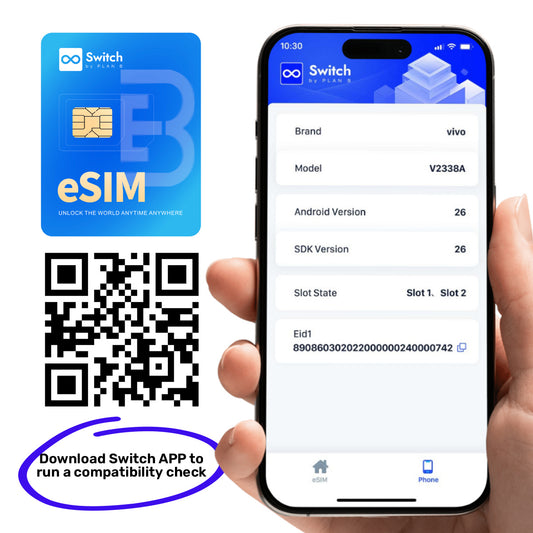
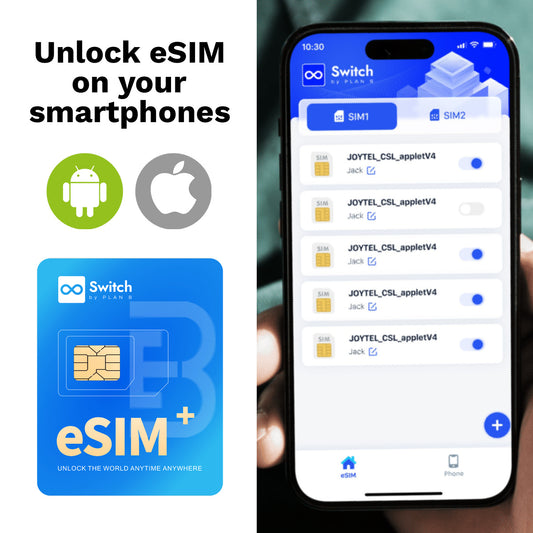
A phone with a free physical SIM slot but no native eSIM chip doesn't need replacing to get eSIM access. Switch Pro is a physical eSIM adapter that fits a compatible Android phone's SIM tray and stores up to 15 eSIM profiles, managed through the Switch Android app. It doesn't add eSIM silicon to the phone — it uses the existing physical slot to hold and switch between profiles instead.
Switch Pro pros:
- Up to 15 stored eSIM profiles on one physical card
- Works on a phone with no native eSIM chip, as long as the SIM slot is free and unlocked
- No need to replace the handset to get multi-profile switching
Switch Pro cons:
- Requires a compatible Android phone with a free physical SIM slot and the Switch app
- One profile active at a time — not simultaneous dual-SIM
- Doesn't work on phones with no physical SIM slot, including US iPhone models
Best for: Android owners who want multi-profile switching without upgrading hardware. Verdict: Buy — for any unlocked Android phone with a spare SIM slot.
6. Compatible iPhone (SIM tray model) + Switch Max: best for exceeding Apple's native eSIM limit
An iPhone with a physical SIM tray can run Switch Max alongside, or instead of, Apple's built-in eSIM. The card is pre-configured before insertion and stores up to 15 profiles, useful for anyone rotating more lines than Apple's two-active setup comfortably handles.
Switch Max pros:
- Up to 15 stored profiles, more than Apple's practical two-active limit
- Works on both Android and compatible iPhone models
- No need to delete and reinstall an eSIM QR code every time you switch lines
Switch Max cons:
- Only works on iPhone models that still ship with a physical SIM tray — not US retail iPhone 14 and later
- Card must be pre-configured before it goes into the phone
- One profile active at a time, matching the phone's own physical-SIM behavior
Best for: iPhone owners with a tray-equipped model managing more than two lines regularly. Verdict: Buy — for tray-equipped iPhones only; skip on US-spec eSIM-only units.


How we ranked
Rankings weigh confirmed eSIM activation, carrier-lock exposure, physical SIM slot presence and simultaneous-profile handling ahead of anything else, because a phone that lists eSIM support on paper but blocks it by carrier lock isn't a real option. Switch eSIM's own hardware is judged by the same physical-slot and profile-count criteria as every phone on this list, not given a pass because it's Switch eSIM's product.
Which unlocked phone with eSIM support should you choose?
Buy the international Apple iPhone 16 if you want native dual-eSIM switching with zero extra hardware. Buy the Samsung Galaxy S24 unlocked if you want a physical SIM backup sitting next to eSIM. If your current phone already has a free SIM slot and you're juggling more lines than its native limit supports in 2026, skip the upgrade — add a Switch Pro on Android or a Switch Max on a tray-equipped iPhone instead, and manage up to 15 profiles on one card rather than buying new hardware.
FAQ
What's the best unlocked phone with eSIM support in 2026?
The Apple iPhone 16 international unlocked model is the best pick for native dual-eSIM switching in 2026, and the Samsung Galaxy S24 unlocked is the best pick for a physical SIM slot alongside eSIM. Both require checking the exact regional variant before buying, since carrier-locked units can restrict eSIM.
Do all unlocked phones support eSIM?
No. 'Unlocked' only means the phone isn't tied to one carrier's contract; it says nothing about eSIM hardware. Confirm eSIM support model-by-model, and check the region and firmware build, since the same phone name can differ by market.
Can I add eSIM to a phone that doesn't have it built in?
Yes, if the phone has a free physical SIM slot: a Switch Pro or Switch Max card fits into that slot and stores up to 15 eSIM profiles without native eSIM hardware. It won't work on a phone with no physical SIM slot at all, including US retail iPhone 14 and later.
Does the Switch Max work on iPhone models without a SIM tray?
No. Switch Max needs a physical SIM tray to insert into, so it fits iPhone models that still ship with one, mainly international, non-US units. US retail iPhones from the iPhone 14 generation onward have no tray, so no card-based adapter fits.
How many eSIM profiles can a phone store natively?
Most Android phones keep one active eSIM profile at a time even when more are stored; the iPhone activates two profiles at once. A Switch Pro or Switch Max card extends that to up to 15 stored profiles on a single physical card.
Is Samsung Galaxy A-series eSIM support the same everywhere?
No. Samsung's A-series eSIM support varies by exact model number, region and firmware build, so a Galaxy A55 bought in one market may not have eSIM enabled at all in another. Check the specific regional SKU before buying for eSIM.
What's the difference between the Switch Pro, Switch Max and the Bluetooth eSIM card reader?
Switch Pro manages profiles through the Switch Android app and fits Android phones with a free SIM slot. Switch Max works the same way but also fits compatible iPhone models with a physical SIM tray. The Bluetooth eSIM card reader loads and manages profiles directly without needing a phone at all.
Is a carrier-locked phone still a good eSIM phone?
Usually not for multi-profile use. A carrier-locked phone can block eSIM activation from any provider other than the original network, regardless of what the spec sheet lists. Buy the unlocked, non-carrier variant if switching between eSIM profiles matters.
One last thing
The spec sheet lists "eSIM support" as a yes/no checkbox, but the real constraint in 2026 is the SIM tray, not the eSIM chip. Every phone on this list that loses its tray also loses the option to ever run a Switch Pro or Switch Max card later, which is why buyers planning to keep a phone for years should weigh tray presence as heavily as eSIM itself.