Does My Phone Support eSIM? 2026 Compatibility Checker
Share
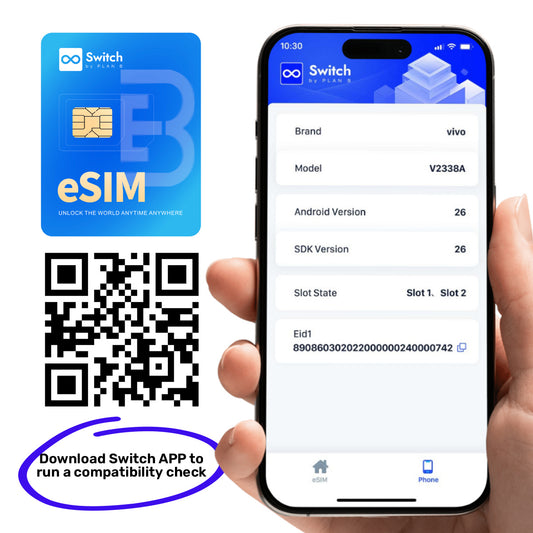
The 30-second check: open your dialler and enter *#06#. If a 32-digit EID appears alongside your IMEI, your phone has eSIM hardware. If only IMEI appears, it doesn't.
On iPhone: Settings → General → About → scroll to EID.
On Android: Settings → Network & internet (or Connections) → SIMs / SIM manager. If you see Add eSIM, Download a SIM, or Add mobile plan, it works.
But an EID is not the whole answer. Plenty of phones show an EID and still refuse to install a profile. Three separate things have to line up:
- Hardware — is there an eUICC chip? (The EID check answers this.)
- Regional firmware — the same model number ships with eSIM disabled in some markets. A Galaxy A54 bought in Europe supports eSIM; the same A54 bought in much of Asia does not.
- Carrier policy — your operator has to issue an eSIM profile for your plan.
Most compatibility lists only answer question 1, which is why so many people buy a travel eSIM that then won't install. Work through all three below.
And if your phone fails on hardware, that isn't the end of it — a phone with a working SIM tray can run eSIM profiles through a physical adapter card regardless of whether it has native eSIM support. Jump to the adapter path ↓
Checking on iPhone
- Settings → General → About. Scroll roughly halfway. If EID is listed, you have eSIM hardware.
- Settings → Cellular (or Mobile Data). Look for Add eSIM or Add Cellular Plan.
- While you're in About, check Carrier Lock. If it reads "No SIM Restrictions," your iPhone is unlocked. Anything else means it's tied to a carrier — see why that's a separate issue ↓.
- Check your model number if you bought the phone in Asia. Settings → General → About → Model Number. A part number ending in ZP/A indicates a Hong Kong or Macao unit, which changes the answer for most models.
Every iPhone from XS, XS Max and XR (2018) onward supports eSIM, per Apple — with two large regional carve-outs covered in the table.
Checking on Android
Android is messier because every manufacturer renames the menu.
| Brand | Path |
|---|---|
| Samsung | Settings → Connections → SIM manager → Add eSIM |
| Google Pixel | Settings → Network & internet → SIMs → + → Download a SIM instead? |
| Xiaomi / Redmi / Poco | Settings → SIM cards & mobile networks → Add eSIM |
| Motorola | Settings → Network & internet → SIMs → Add eSIM |
| OnePlus / OPPO | Settings → Mobile network → Add eSIM |
| Any brand, fallback | Settings → About phone → Device details / Status → look for EID |
Two Android-specific traps:
Update first, then check. eSIM options are sometimes gated behind a carrier configuration bundle that arrives with a system update. If Add eSIM is missing on a phone that should have it, update and re-check before concluding anything.
The dial code is more reliable than the menu, but the menu is more meaningful. *#06# reads the hardware. The Settings menu reflects whether the software will actually let you use it. If the EID shows but Add eSIM doesn't, you almost certainly have a region-locked or carrier-locked variant — the hardware is there and disabled.
iPhone compatibility
| Model | Year | Native eSIM | SIM tray? | Regional notes |
|---|---|---|---|---|
| XS, XS Max, XR | 2018 | Yes | Yes | XS is one of the few HK/Macao models with eSIM |
| 11, 11 Pro, 11 Pro Max | 2019 | Yes | Yes | China mainland and most HK/Macao units: dual nano-SIM, no eSIM |
| SE (2nd gen) | 2020 | Yes | Yes | HK/Macao variant does support eSIM |
| 12 mini, 12, 12 Pro, 12 Pro Max | 2020 | Yes | Yes | 12 mini supports eSIM in HK/Macao; others don't |
| 13 mini, 13, 13 Pro, 13 Pro Max | 2021 | Yes | Yes | First generation with two active eSIMs; 13 mini OK in HK/Macao |
| SE (3rd gen) | 2022 | Yes | Yes | — |
| 14, 14 Plus, 14 Pro, 14 Pro Max | 2022 | Yes | US: no tray | First eSIM-only US iPhones |
| 15 series | 2023 | Yes | US: no tray | — |
| 16, 16e, 16 Plus, 16 Pro, 16 Pro Max | 2024–25 | Yes | US: no tray | International 16e adds a tray |
| 17, 17e, 17 Pro, 17 Pro Max | 2025 | Yes | No tray in ~10 markets incl. US, Canada, Japan, Mexico, UAE, Saudi Arabia | 17e (A3635) is one of only two iPhones with eSIM in China mainland |
| iPhone Air | 2025 | Yes | No tray, worldwide | Model A3518 — supports eSIM in China mainland |
| X, 8, 8 Plus, 7, 6s, SE (1st gen), earlier | ≤2017 | No | Yes | No eSIM hardware — but the adapter path works ↓ |
China mainland: Apple confirms only iPhone 17e (A3635) and iPhone Air (A3518) support eSIM there. Every other China-market iPhone ships dual nano-SIM with no eSIM, and that limitation travels with the phone — a China-bought iPhone 16 still can't install an eSIM in London.
Hong Kong / Macao: most recent models use two physical nano-SIM slots instead of eSIM. Apple confirms "certain models" differ; third-party lists consistently name the Air, 13 mini, 12 mini, SE (2020) and XS as the exceptions. Verify against your own device before relying on it.
Samsung Galaxy compatibility
The A-series is where people get caught, so read the region column carefully. These entries are from Samsung's own support pages:
| Model | eSIM | Region restriction |
|---|---|---|
| S23, S23 Ultra, S23 FE | Yes | — |
| S24, S24 Ultra, S24 FE | Yes | — |
| S25, S25 Ultra, S25 FE | Yes | — |
| S26, S26+, S26 Ultra | Yes | — |
| Z Fold 4, 5, 6, 7, 8 | Yes | Original Fold: no eSIM |
| Z Flip 4, 5, 6, 7, 8 | Yes | — |
| A54 5G | Yes | Europe, North America, Korea, Japan only |
| A55 5G, A56, A57 5G | Yes | — |
| A35 5G, A36 5G | Yes | Europe, North America, Korea only |
| A23 5G, A25 5G | Yes | Listed on Samsung Japan's page |
| XCover 7, XCover 7 Pro | Yes | — |
| Tab S9 FE+ 5G | Yes | — |
"Is the Samsung A54 eSIM compatible?" — Yes, if it was sold in Europe, North America, Korea or Japan. Samsung explicitly limits A54 eSIM support to those regions. An A54 bought in India, Southeast Asia, the Middle East or Latin America will not have it. Same model name, same box, different firmware. Dial *#06# on the actual handset.
Not confirmed: the S20, S21, S22 and Note 20 families are very widely listed as eSIM-capable by third parties, and probably are, but they did not appear on the Samsung support pages we could access. The S20 FE and S21 FE in particular are frequently reported as eSIM-disabled in several markets. Treat all four families as "check your handset." Samsung's own regional support pages also list slightly different device sets against each other, which is itself a good reason to trust the dial code over any list, including ours.
Google Pixel compatibility
Google's documentation is the clearest of the three:
| Model | eSIM | Notes |
|---|---|---|
| Pixel 4 and later | All models | Universally supported |
| Pixel 10, 10 Pro, 10 Pro XL | Yes | US models: eSIM only, no physical SIM. Pixel 10 Pro Fold keeps its tray |
| Pixel 7 and later | Yes | Can run two eSIM profiles at once, carrier permitting |
| Pixel 3a, 3a XL | Mostly | Not Verizon models; not Japan models. Japanese 3a can't do dual SIM at all |
| Pixel 3, 3 XL | Partly | Not US/Canadian carrier models except Sprint and Google Fi; not Australia, Taiwan or Japan |
| Pixel 2, 2 XL | Only via Google Fi | Fi-purchased units only |
| Pixel (2016) | No | No eSIM hardware |
One more Pixel quirk: Pixel 8 and later reject some older physical SIM cards outright, showing "This SIM is no longer supported." That's a SIM-generation issue, not an eSIM one, but it sends people down the wrong diagnostic path.
Other brands
We could not verify these against manufacturer documentation before publication, so treat this section as directional and confirm with *#06#:
- Xiaomi / Redmi / Poco — eSIM appears on recent global flagships and some Redmi Note Pro models. China-market units generally do not support eSIM, and Xiaomi's global/China split is aggressive.
- Motorola — Razr foldables and recent Edge models widely support it.
- OnePlus / OPPO — recent flagships yes; units sold in China, Hong Kong, Macao or India typically do not.
- Honor, Sony Xperia, Fairphone, Huawei — patchy and model-specific. Huawei support is limited.
The pattern across every Android brand is the same: global variant yes, China/HK/Taiwan variant usually no, India frequently no.
These get conflated constantly, including by support staff, so here is the distinction.
A carrier lock is a software restriction on which networks' SIMs your phone will accept. It says nothing about eSIM hardware. A carrier-locked iPhone 15 has a fully functional eUICC — it just won't accept a profile from a network other than the one that locked it.
Practical consequences:
- A locked phone can usually still install and use an eSIM from its own carrier. Locked ≠ eSIM-disabled.
- A locked phone will typically reject a third-party travel eSIM, because that's a different network. The failure looks identical to an incompatibility error, which is why people misdiagnose it.
- Check your lock status before blaming the eSIM. iPhone: Settings → General → About → Carrier Lock. "No SIM Restrictions" means unlocked. Android varies; ask your carrier.
- Unlocking is usually free and quick once your contract or device payments are complete. If a travel eSIM won't install, request an unlock before buying different hardware.
The confusing third case: some carrier variants ship with eSIM firmware disabled entirely — US carrier-locked Galaxy models are the commonly cited example. Here the phone is both locked and eSIM-disabled, and unlocking may not restore the eSIM function. That's the one scenario where the two issues genuinely overlap.
If *#06# shows no EID, your phone has no eSIM chip and no software update will add one. But you have a second route, and it's more widely applicable than most people realise.
A physical eSIM adapter card is a programmable eUICC on a nano-SIM form factor. It goes in your SIM tray and presents to the phone as an ordinary SIM. The card does the eUICC work; the phone doesn't need to know what an eSIM is.
Which means: native eSIM support is irrelevant to the adapter path. What actually matters is:
- A working physical SIM tray. This is the hard requirement.
- Carrier unlock. An adapter can't defeat a network lock — profiles you load will still be rejected by a locked handset.
- A way to write profiles onto the card. On Android, an app talks to the card through the SIM slot. On iPhone, iOS gives no third-party app that access, so you need a USB or Bluetooth card reader to write profiles. Once written, switching between them works on any phone via the SIM Toolkit menu.
Phones that can use an adapter but not native eSIM
- iPhone X, 8, 8 Plus, 7, 6s, SE (1st gen) and earlier — no eSIM hardware, full SIM tray. Adapter works with a reader.
- China mainland iPhones (11 through 16) — eSIM deliberately absent, two nano trays available. One of the strongest use cases there is.
- Hong Kong / Macao dual-SIM iPhones — same situation.
- Samsung A54 and A35/A36 sold outside Europe/NA/Korea — firmware-disabled eSIM, working tray.
- Pixel 3 and 3a on excluded carriers or in Australia, Taiwan, Japan — same.
- Any budget Android without eSIM — the largest category by volume.
Phones that cannot use an adapter at all
Be clear-eyed about this: eSIM-only phones have no SIM tray, so no adapter fits. That includes US iPhone 14/15/16 models, iPhone 17 in the ~10 eSIM-only markets, iPhone Air worldwide, and US Pixel 10 / 10 Pro / 10 Pro XL. If you own one of these, native eSIM is your only option and an adapter is not a solution to anything.
[Internal link: which physical eSIM card to buy → comparison]
FAQ
Can a software update add eSIM to my phone? No. The eUICC is a physical chip. Updates can enable eSIM on hardware that already has it — which is why updating is worth trying if the EID shows but Add eSIM doesn't — but they can't add the chip.
My phone shows an EID but says "eSIM not supported." Almost always a region-locked or carrier-locked variant. The hardware exists and the firmware won't use it. Update, check your lock status, then consider the adapter path.
How many eSIM profiles can I store? Apple says recent iPhones hold eight or more, with one or two active at a time depending on model. Android varies widely. Storing many and activating one or two is normal.
Does eSIM work if I travel to a different country? The hardware does. The restrictions travel with the phone, though — a China-market iPhone stays eSIM-incapable abroad, and eSIMs from China mainland carriers can't be installed on devices bought elsewhere.
Is *#06# safe to dial? Yes. It's a standard GSM information code that displays local hardware identifiers. It makes no call and sends nothing.
Do tablets and watches work the same way? Tablets must be the Wi-Fi + Cellular version. Watches generally need a carrier-specific wearable plan, not a travel eSIM.
Learn more:
- Use eSIM while traveling internationally with your iPhone — Apple Support
- Set up eSIM on iPhone — Apple Support
- Using eSIM with your iPhone in China mainland — Apple Support
- [Galaxy eSIM and supported network carriers — Samsung](https://www.samsung.com/bd/support