eSIM Adapter vs Buying a New Phone: The Real Cost Breakdown
Share
Short answer: a removable eSIM card runs roughly $15–30, and a management reader (if you need one) adds another $25–30. The cheapest brand-new phone with working eSIM is $199.99. So the adapter is around 4–7× cheaper, not the 30× some comparisons imply. But the more important number is zero — because a lot of people asking this question already have eSIM and don't need to buy anything. Dial *#06# before you spend money.
Disclosure: published by Switch eSIM, which sells removable eSIM cards. This article recommends against buying one in four specific situations. Prices are US, dated [DATE], and move constantly.
Step zero: you may already have eSIM
The most common mistake in this category is buying an adapter for a phone that didn't need one.
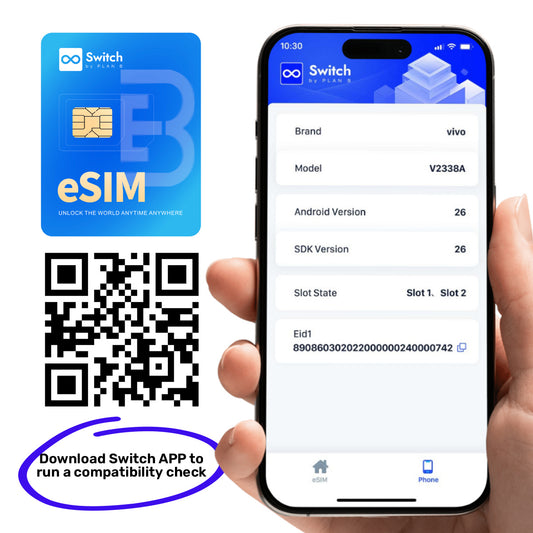
On Android: dial *#06#. If an EID appears alongside the IMEI, your phone has an eUICC and you're done — buy a travel eSIM, not hardware.
On iPhone: Settings → General → About, look for EID or "Digital SIM."
Do not use model year as a proxy. This is the part almost every listicle gets wrong:
- Samsung's own compatibility page carries the qualifier that "depending on the country of origin, eSIM may not be supported even if your device is listed above."
- The Galaxy S20 FE does not support eSIM in any variant, despite the S20 line broadly doing so.
- Most A-series below the A35 don't — which disproportionately affects buyers in India, the Philippines, Indonesia and Nigeria, where mid-range A-series dominates.
- OnePlus units sold in China, Hong Kong, Macao or India typically don't, even where international models of the same phone do.
- The Nothing Phone (3a), a 2025 release, restricts eSIM to Japan.
- Apple states that in mainland China only iPhone 17e and iPhone Air support eSIM; Hong Kong and Macao models are a separate, narrower list.
A 2025 flagship bought in the wrong market can have no usable eSIM. A 2019 Pixel bought in the US can have one. Check the phone in your hand.
The cost table: four scenarios
| Scenario | Adapter route | New-phone route | Gap |
|---|---|---|---|
| 1. Older single-SIM Android, no eSIM, occasional traveller | Card ~$15–30 + reader if needed ~$28.54 = $15–59 | Moto G (2026) $199.99 or Galaxy A16 ~$180 | ~$140–185 |
| 2. Hybrid dual-SIM Android (SIM2/microSD), keeps home line | Card in slot 2 = $15–30 | Pixel 9a $399 (clearance) | ~$370–384 |
| 3. iPhone with SIM tray, non-US model, pre-XS | Card ~$15–30, but iOS has no management app — reader or on-card STK menu required | iPhone 17e $599 / used iPhone 13 ~$400–500 | ~$370–570 |
| 4. iPhone 14+ (US), 17 series in eSIM-only markets, iPhone Air | Not possible — no SIM tray exists | n/a — already has eSIM | $0, buy nothing |
Prices: Moto G (2026) $199.99 and Galaxy A16 ~$180 per Holafly and Android Police (Dec 2025); Pixel 9a $399 clearance and iPhone 17e $599 per Holafly (May 2026); used Pixel 8a "under $200" per the same source. Adapter card pricing is marked as a range because I could not verify Switch's own current SKU prices before publication — see notes.
The honest problem with this comparison
A phone and an adapter are not substitutes. The $199.99 Moto G also buys you a new battery, a current Android version, and — critically — a security-update window. The adapter buys you exactly one feature.
So the comparison above is only valid if eSIM is the sole reason you'd replace the phone. If your battery is dying, or you're past your security-update cutoff, the adapter isn't a saving; it's a deferral of a purchase you need anyway. Worth noting on that point: the Moto G (2026) ships with two years of OS support, while the Galaxy A16 offers six. A cheap phone that stops receiving patches is its own cost.
Also missing from most breakdowns: the local SIM. For a single trip to a single country, a prepaid physical SIM bought on arrival often costs $10–30 and requires no new hardware, no app, and no compatibility research. If that describes your trip, the cheapest correct answer may be neither product.
When the adapter is the wrong call
1. Your phone has one SIM tray and you need two lines. This is the big one. The adapter occupies the tray. On a single-tray phone, inserting it means removing your everyday SIM — so you can store many travel profiles but your home number is out of the device. You have not gained dual-SIM; you've gained a switchable single line. Only hybrid (SIM2/microSD) or true dual-nano-SIM phones let you keep the home line and add the adapter alongside it.
2. You want two eSIM profiles active simultaneously. That's MEP (Multiple Enabled Profiles), an Android 13+ feature requiring modem, eUICC and OS support together — per AOSP, "device manufacturers must work with SoC vendors and eSIM chipset vendors to integrate this feature." Google lists dual-active-eSIM as Pixel 7 and later, carrier permitting. A removable card in a physical tray does not provide MEP. If you need two lines genuinely concurrent, you need a phone that supports it.
3. You have no SIM tray. iPhone 14 and later US models, the iPhone 17 line in the twelve eSIM-only markets, and the iPhone Air globally have no tray. There is nowhere to put the card. (These phones already have eSIM, so the point is only that an adapter can never be the answer for them.)
4. You're not comfortable with sideloaded apps, QR codes, or card readers. Two documented friction points: iOS has no removable-eUICC management app at all, so iPhone users depend on an on-card STK menu or a reader. And a recurring complaint on the XeSIM Play listing is that vendor compatibility lists cover STK-menu devices, not app-compatible devices — meaning some buyers can't write a first profile to a blank card. If setup failure would leave you stranded abroad, this is a real risk, not a theoretical one.
Three-year total cost
Adapter route, honestly costed:
| Line item | Cost |
|---|---|
| Card | $15–30 |
| Reader (Android app-compatible devices may not need one; iOS generally does) | ~$28.54 |
| Profile download credits, if the vendor meters them | Unknown — ask |
| Replacement if a card fails | 1× card |
| Vendor ceasing operations | Existing profiles keep working; adding new ones may not |
| 3-year total | ~$15–90 |
That vendor-shutdown line isn't hypothetical. 5ber's backend stopped serving requests in spring 2025; users reported working profiles but no ability to add new ones, and one user found licences weren't carried over to the successor product. Metered download credits are the mechanism by which that became a financial loss rather than an inconvenience. Ask any vendor — us included — whether downloads are metered.
New-phone route: $180–599, minus resale or trade-in of the old handset, which for a working phone is often $50–150 and materially narrows the gap.
On e-waste, the defensible version: 62 million tonnes of e-waste was generated globally in 2022, projected to reach 82 million tonnes by 2030, with only 22.3% documented as formally collected and recycled (Global E-waste Monitor 2024, ITU/UNITAR). Manufacturing dominates a phone's footprint — Apple's own LCA puts the iPhone 15 at 56 kg CO₂e with 80% from production, and the iPhone 17e at 47 kg. So deferring a handset purchase avoids real emissions.
But the honest framing is that keeping your phone is what avoids them, not buying an adapter specifically. If you'd have kept the phone anyway, the adapter's climate benefit is zero. We're not going to dress up a $20 accessory as an environmental intervention.
Decision tree
Follow in order. Stop at the first outcome.
-
Dial
*#06#(Android) or check Settings → General → About (iPhone). Is there an EID?
→ Yes: you have eSIM. Buy nothing. Buy a travel data plan.
→ No: continue. -
Does the phone have a physical SIM tray?
→ No: an adapter is physically impossible. Stop.
→ Yes: continue. -
Is the phone past its security-update window, or is the battery failing?
→ Yes: replace the phone. The $199.99 tier has eSIM. An adapter defers a purchase you need.
→ No: continue. -
Do you need two lines active at the same time?
→ Yes: you need an eSIM phone with MEP (Pixel 7+, carrier permitting) or a dual-tray phone. An adapter cannot do this.
→ No: continue. -
Is it one trip, one country, and you'll be mostly stationary?
→ Yes: a local prepaid SIM is probably cheaper and simpler.
→ No — multiple countries, or recurring travel: continue. -
Does your phone have a hybrid (SIM2/microSD) or second nano-SIM slot?
→ Yes: an adapter is a good fit. Home line stays in slot 1.
→ No, single tray: an adapter works but evicts your home SIM. Only proceed if you're willing to run one line at a time. -
iPhone? Confirm the card offers an on-card STK menu, or budget for a reader. There is no iOS management app.
-
Before buying, ask the vendor: are profile downloads metered? Is there a USB CCID reader path if your app stops working? What chip is inside?
Limitations
Prices are US-market, dated, and volatile; carrier promotions routinely undercut the figures above. Adapter card pricing is given as a range because Switch's own SKU pricing was not verified before this draft. The reader requirement varies by phone and by card and can't be stated universally. Carbon figures are Apple's own LCA disclosures for Apple products and don't generalise cleanly to Android. We found no reliable data on whether specific carriers refuse to provision profiles to third-party eUICCs — it's plausible and frequently claimed, but we're not asserting it without a source.
Learn more:
- Global E-waste Monitor 2024 (ITU/UNITAR) — 62 Mt in 2022, 82 Mt by 2030, 22.3% recycled
- Global E-waste Monitor 2024 press release — growth outpacing recycling by ~5×
- Apple iPhone 15 Product Environmental Report — 56 kg CO₂e, 80% from production
- Apple iPhone 17e Product Environmental Report (Mar 2026) — 47 kg CO₂e
- AOSP — Multiple Enabled Profiles (MEP): Android 13+, requires SoC and eUICC vendor integration
- Google Pixel support — dual-active eSIM requires Pixel 7 or later and carrier permission
- Android Faithful —
adb shell pm has-feature android.hardware.telephony.euicc.mepto test MEP support - Holafly — cheapest new eSIM phones: Moto G (2026) $199.99, Pixel 9a $399, iPhone 17e $599
- Android Police — Moto G (2026) vs Galaxy A16 at $200; 2-year vs 6-year OS support
- CommBitz —
*#06#EID check; India/HK/Korea variant exclusions; Galaxy S20 FE has no eSIM - US Mobile — regional exclusions: S23 FE (China/HK), OnePlus (China/HK/Macao/India)
- Roam Index — Apple's stated per-region eSIM qualifiers, including mainland China and Hong Kong/Macao
- Thewearify — budget-phone eSIM firmware limits, e.g. Nothing Phone (3a) restricted to Japan
Learn more:
- The Roam Index — eSIM device compatibility reference for travellers
- Which Phones Support eSIM 2026? The Complete List
- Does My Phone Support eSIM? Full Device Compatibility List 2026
- The Complete eSIM Compatibility Guide for iPhone and Android
- Does Your Phone Support eSIM in 2026?
- Phones That Don’t Support eSIM in 2025
- ESIM Compatible Devices: Phones & Tablets
- Does Your Phone Support eSIM in 2026?
- Android Open Source Project
- Here's every Android phone with dual eSIM support
- Android Open Source Project
- Utiliser deux SIM sur votre téléphone Google Pixel
- How to use dual SIMs on your Google Pixel phone
- How to use dual SIMs on your Google Pixel phone
- How to use dual SIMs on your Google Pixel phone
- Detect eSIMs and SIM cards
- Specs, Prices and How to Pick the Right One
- Top 4 cheapest eSIM phones to buy in 2026
- Top 10 Cheap Phones Tested – Tech Advisor
- 9 Best Cheap Phone With eSIM
- Cheapest eSIM phones: Their models and features
- I used the Moto G 2026 and Samsung Galaxy A16, and only one makes sense for $200
- One moment, please...
- List updated August 2026 - Holafly
- Environment
- Environment
- Environment
- iPhone 17e_PER_Mar2026_EU
- Environment
- Apple surpasses 60 percent reduction in global greenhouse gas emissions
- wikipedia.org
- iPhone 15 and iPhone 15 Plus Product Environmental Report
- E-waste
- The Global E-waste Monitor 2024
- A Review of Traceability, Compliance and Circular Economy Applications
- ASUS ESG website, ASUS ESG goal
- wikipedia.org
- The Global E-waste Monitor 2024