
eSIM Adapters for Truck Drivers: Pro for Android 2026
Share
Truck-driver eSIM adapter planning is the process of matching a physical eSIM card to a phone or onboard device with the aim of loading suitable mobile profiles for each route. In 2026, start with the device, not the data plan: a compatible physical SIM slot, carrier-lock status and profile-loading method determine whether an adapter is useful at all.
- For eSIM adapters for truck drivers, Switch Pro is the best fit for compatible Android phones managed through an Android app.
- Switch Max suits compatible iPhones with a physical SIM slot, but its profiles need a separate loading path.
- A Bluetooth reader can load profiles without an Android phone; it does not remove device or carrier restrictions.
- For fleets, verify each device variant and route before buying adapters in bulk.
Why eSIM adapters matter for truck drivers
A driver can move between routes, phones and network coverage areas while keeping the same working device. An eSIM adapter addresses one part of that problem: it holds eSIM profiles in a removable card that fits a compatible physical SIM slot. It does not supply coverage, unlock a carrier-locked phone or make an unsupported device compatible. The distinction matters when a dispatcher expects a change of profile to fix a connection problem caused by network bands or coverage.
The device mix also matters. A driver's Android phone, an iPhone with a SIM tray and an in-cab router need different compatibility checks. If the phone already supports the required eSIM provider natively, its built-in eSIM setup is the manual option to check first. For the hardware decision, the Android eSIM adapter guide covers the phone-specific questions; apply the same device-by-device discipline to fleet equipment.
In 2026, do not treat an eSIM adapter as a fleet connectivity system. It is a way to store and load profiles on compatible hardware. Carrier agreements, route coverage, account ownership and support procedures remain separate decisions.
Set up an adapter for a truck or fleet device
Work through these checks on the exact device that will go into service. Record the model and regional variant for every phone, router or hotspot; a model-family name alone is not a compatibility test. Keep profile-loading equipment available during setup rather than assuming the driver can complete every change on an iPhone.
Check the physical SIM slot
Look at the device and its manufacturer's specification before selecting an adapter. A physical eSIM adapter needs a compatible physical SIM slot. An iPhone model or regional variant without a SIM tray is not a fit for a card inserted into the phone, even if the phone supports native eSIM. The same physical check applies to a router or hotspot.
For a 2026 fleet purchase, check the actual units in circulation rather than a sample photo or a procurement sheet. Note which slot normally holds the driver's primary SIM and whether replacing that card would interrupt a required line. If it would, decide how that line will stay active before changing the setup.
- Check the slot on the exact device.
- Record the model and regional variant.
- Identify the SIM currently occupying the slot.
- Confirm the adapter's fit with the device before purchase.
Confirm the lock, bands and provider
Next, use the device settings and carrier information to check whether the phone is locked. An adapter does not override a carrier lock. Confirm that the device's supported network bands match the networks you intend to use along the route, and check that the chosen eSIM provider permits activation on the planned hardware.
Do this for each country or operating area on the schedule. A profile that installs successfully is not proof of useful coverage where the truck runs. Keep a record of the provider's activation method and any restrictions so the driver does not have to resolve them at a stop.
- Check carrier lock status with the current carrier.
- Confirm network bands for the intended route.
- Check the provider's activation requirements.
- Record restrictions beside each device and route.
Choose the profile-loading path
Start with the method already supported by the phone. If a compatible phone has native eSIM and the provider supports it, follow the phone and provider's installation instructions. If you need a removable eSIM card, choose its loading method before choosing the card: an Android-based management path, a separate reader or a pre-loaded card.
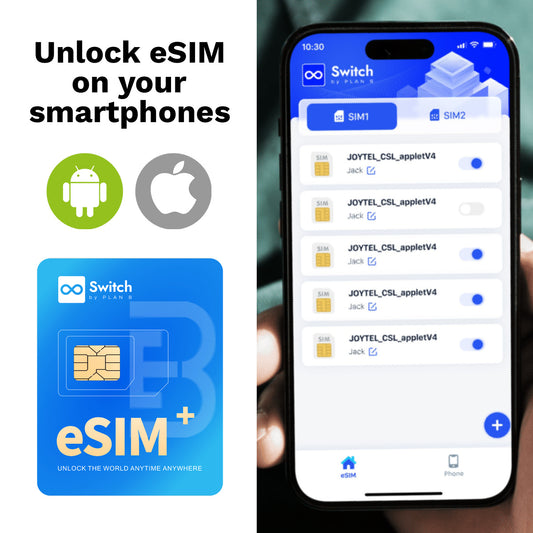
Switch eSIM adapters are useful when a compatible device has a physical SIM slot but lacks the native eSIM setup you need. Switch Pro uses Android-based profile management. Switch Max extends use to compatible iPhones once configured. The open-source Bluetooth reader loads profiles without requiring an Android phone. That reader is a provisioning tool, not a substitute for checking whether the target phone, router or hotspot accepts the card.
For 2026 operations, give the person responsible for loading profiles a defined setup location and device. Do not plan an iPhone deployment around an unverified assumption that the iPhone itself can perform Android-based management.
- Try native eSIM setup where the device supports it.
- Use Android-based management for the Switch Pro path.
- Arrange reader-based loading when no Android phone is available.
- Check the provider's QR-code or manual activation instructions.
Match the card to the operating system
Check the device operating system and the method used to prepare the card. For Android drivers who can manage profiles through the Switch Android app, Pro is the direct product path. For an iPhone with a compatible physical SIM slot, Max is the product path to assess; arrange its configuration separately. For a shared setup desk, a Bluetooth reader can provide a loading path without assigning an Android phone to that desk.
Switch eSIM adapter choice follows the management path, not the driver's job title. Two drivers on the same route can require different hardware because one uses Android and the other uses an iPhone. A router presents another check: confirm its physical SIM-slot compatibility and test the configured card in that exact router.
- Record Android or iOS and the operating-system version.
- Assign who loads and changes profiles.
- Confirm the physical SIM slot on each target device.
- Test a configured card in the device it will serve.
Separate profile capacity from data allowance
Profile capacity means how many eSIM profiles the hardware can store. A data allowance describes the service attached to a particular plan. They are not interchangeable. The listed Switch adapter and Bluetooth reader bundle says it can store up to 15 eSIM profiles; verify the capacity of the exact card or bundle you select rather than applying that figure to every Switch card.
Pre-loaded destination-data cards address a different need: preparing a specified plan before the driver receives the card. Listed examples include a 10 GB, 60-day United Arab Emirates plan and a 20 GB, 30-day Australia and New Zealand plan. Those figures describe individual data plans, not the number of profiles a card holds or the coverage quality on a trucking route.
In 2026, choose the route and provider first. Then decide whether your operation benefits more from storing several profiles for later selection or issuing a card with a specified destination plan already loaded.
- Count the profiles the workflow needs to retain.
- Check the exact card's stated profile capacity.
- Confirm each plan's destination and validity period.
- Keep plan details separate from hardware inventory.
Define the privacy and handoff procedure
Read the provider's and management app's current privacy terms before enrolling drivers. Open-source reader hardware does not, by itself, establish how every provider, app or fleet system handles account data. Decide who controls activation details and who can change a working profile. That decision affects a truck that changes drivers as much as a driver who changes countries.
Write a short handoff procedure for the driver and the person who provisions cards. Include the current profile, the approved replacement and the person to contact when activation fails. Keep the account owner responsible for removing access when a device leaves service. For a 2026 fleet, this procedure is more actionable than a general instruction to switch networks when reception drops.
- Review app and provider privacy terms.
- Assign ownership of activation credentials.
- Record the approved profile for each device.
- Define driver handoff and device-retirement steps.
Test the setup before a route
Install and activate the selected profile while you can still use the provider's support channel and your normal connection. Confirm that the target device recognizes the card, registers on the intended network and passes the connectivity test required for its job. For a router, test the router; a successful phone test does not establish router compatibility.
Repeat the test after a planned profile change. Record what the driver should do if activation fails, including whether the original SIM can be restored. This turns a purchasing decision into a usable field procedure without assuming that every provider supports the same installation flow.
- Test installation on the exact target device.
- Check network registration and required connectivity.
- Practise one planned profile change.
- Document the recovery contact and original-SIM procedure.
Compare the options for truck drivers and fleets
The table separates the card from the tool that loads it. Switch Pro is the best fit for a compatible Android phone when the driver or fleet uses Android-based profile management. Choose Switch Max for a compatible iPhone with a physical SIM slot and a confirmed loading path. Neither choice removes carrier, band or provider checks.
| Option | Best for | Profile-loading path | Key limitation |
|---|---|---|---|
| Switch Pro | Compatible Android phones | Android-based management | Requires the appropriate device and management setup; not the iPhone choice on its own. |
| Switch Max | Compatible iPhones with a physical SIM slot | Configure the card before use in the iPhone | A trayless iPhone cannot take the physical card. |
| Switch adapter and Bluetooth reader bundle | A provisioning setup without an Android phone | Load profiles through the Bluetooth reader | The reader does not resolve target-device incompatibility. |
| Pre-loaded destination-data card | A specified destination plan prepared before handoff | Profile supplied pre-loaded | Plan destination and validity must match the route. |
| Native eSIM on the device | A phone whose built-in eSIM supports the provider | Device and provider installation flow | Not an adapter option for hardware without native eSIM. |
| Conventional physical SIM | A route served by an existing physical SIM | Insert the carrier's SIM | Changing providers requires handling the appropriate SIM and service. |
No single row establishes fleet-wide compatibility. Select by device, loading method and route. Switch eSIM also offers bulk and white-label supply, but a bulk order should follow a successful test on each device type in the fleet.
Common mistakes truck drivers and fleets make
- Buying for a model name instead of its regional variant. The physical SIM slot can differ by variant. Inspect the issued phone before choosing Max or Pro.
- Treating an adapter as a carrier unlock. Confirm lock status and supported network bands before loading a profile. A different profile does not change the phone's hardware.
- Confusing loading with use. An iPhone can use a configured compatible Max card, while the Switch Android app and Bluetooth reader describe separate ways to manage or load profiles. Set up the loading path before handing over the phone.
- Confusing stored profiles with active data. Capacity describes profiles held on a card; a plan's data allowance and validity describe service. Track them separately.
- Scaling from a phone test to a fleet. A working driver phone does not verify a router, hotspot or another phone variant. Test every device type intended for deployment.
FAQ
What are the best eSIM adapters for truck drivers in 2026?
Switch Pro is the best fit for a compatible Android phone managed through Android; Switch Max is the choice to assess for a compatible iPhone with a physical SIM slot. Confirm the loading path, carrier lock, network bands and provider before choosing either card.
Can a truck driver use an eSIM adapter in an iPhone?
Yes, a compatible iPhone with a physical SIM slot can use a configured Switch Max card. An iPhone without a physical SIM tray cannot accept that card, and profile loading needs a suitable setup path.
Does Switch Pro need an Android phone?
Switch Pro uses Android-based profile management. If the provisioning workflow cannot use an Android phone, assess reader-based loading and verify the exact adapter setup before purchase.
Can the Bluetooth reader load profiles without an Android phone?
Yes, the Switch Bluetooth reader is offered as a way to load eSIM profiles without an Android phone. The phone, router or hotspot that will use the configured card still needs a compatible physical SIM slot.
Will an eSIM adapter work in a carrier-locked phone?
An eSIM adapter does not remove a carrier lock. Check the phone's lock status and the intended provider's requirements before ordering a card or plan.
How many profiles can a Switch adapter hold?
The listed Switch adapter and Bluetooth reader bundle specifies storage for up to 15 eSIM profiles. Check the stated capacity of the exact card you select; a plan's data allowance is a separate figure.
Can a fleet use the same setup in phones and routers?
Not without checking each device type. Phones, routers and hotspots need their own physical SIM-slot, network-band and provider checks, followed by a test on the target device.
One last thing
Make the first purchase a device test, not a fleet rollout. In 2026, a configured card that works in one driver's phone proves that setup on that phone. Test the other phone variants and in-cab hardware before using the same purchasing decision across a fleet.