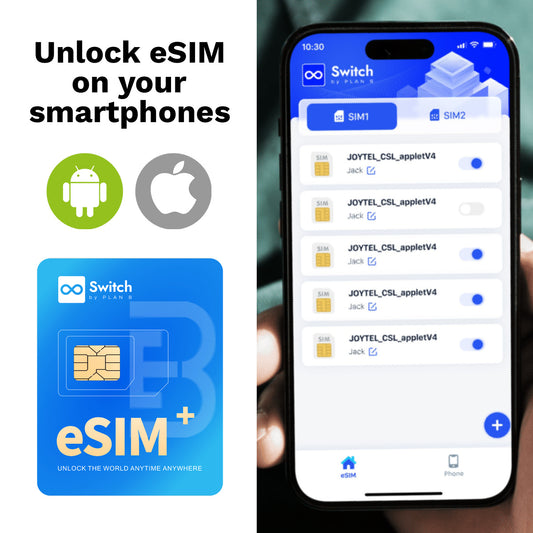
How Many eSIM Profiles Can You Store?
Share
Short answer: most removable eSIM cards advertise 15 stored profiles and iPhones advertise "eight or more," but you will hit one of three different ceilings first — a licence tier you paid for, the card's non-volatile memory in KB, or the number of profiles that can be active at once (usually one on a removable card, two on a modern iPhone). These are separate limits with separate causes. Most travellers never need more than two or three.
Disclosure: published by Switch eSIM, which sells removable eSIM cards. This article explains why advertised profile counts overstate what you'll get, including on our own product. Capacity figures for Switch cards are marked unverified — see limitations.
Three ceilings, not one
| Ceiling | What sets it | Typical value | How you find out |
|---|---|---|---|
| Licence / download quota | The vendor's commercial tier | eSIM.me: 2, 5, 7, 10 or 15 by licence · 5ber Standard: 2 free downloads then paid | App refuses before any network request |
| eUICC memory (KB) | Chip NVM minus each profile's size | Unknown per-product; eUICC spec floor historically ~512 KB | Download fails partway with an out-of-space error |
| Active profiles | Modem and eUICC port architecture | 1 on most removable cards · 2 on iPhone 13+ · MEP on Pixel 7+ | Enabling one profile disables another |
Hitting the first is a purchase decision. Hitting the second is physics. Hitting the third has nothing to do with storage at all — and it's the one most people are actually complaining about when they say a card "only holds one."
Why the honest number is measured in KB
A profile is not a number. It's a filesystem: an ISD-P security domain, a USIM (and often ISIM) application, authentication keys, elementary files, and frequently optional extras — SIM Toolkit applets, OTA/RFM channels, carrier menus. A minimal data-only travel profile and a full carrier profile with a toolkit menu differ substantially in size.
For scale: a traditional single-profile SIM typically carried 64 KB or 128 KB of memory, and eUICC implementations were described as requiring a minimum of 512 KB when the technology was being commercialised. Treat that 512 KB as a historical floor, not a current spec — it's from a 2016 industry source and modern chips vary.
Eseye, which ships eUICCs commercially, states the position plainly: the number of profiles storable "is limited only by the memory available and the size of each network operator's profile."
This is why the conversion table you were looking for doesn't exist. Divide memory by profile size and you get an answer that changes depending on which carriers you load. Two people with identical cards can legitimately fit different numbers of profiles. Apple's phrasing — "you can store eight or more eSIMs," with no stated maximum — is widely read as evasive, and Macworld has noted the oddity, but it's arguably the most accurate thing anyone in the industry says about capacity.
What I could not obtain: measured sizes, in KB, of real travel-eSIM profiles. The Osmocom eUICC manual maintains a profile database and an "Anatomy of the eSIM profile" write-up that likely contain these figures; I couldn't retrieve them before publication. Until someone does, any specific KB-per-profile number on the web is an estimate wearing a lab coat.
How to actually measure free memory
If you have a card reader and are comfortable with APDUs, GlobalPlatform's GET DATA with tag FF21 returns Extended Card Resources Information, which includes free non-volatile memory (tag 82) and free volatile memory (tag 83).
Three caveats, all real:
- Support is manufacturer-dependent. It is not guaranteed on any given card.
- Java Card APIs commonly cap returned values at 32,767, so large figures may be truncated or reported differently.
- Cards reserve memory for transactions and internal operations, so "free" is not "usable by you."
There is no way to do this from a phone UI. If a vendor won't state capacity in KB, the practical answer for most users is that you find out by filling the card.
What happens when you hit the limit
Profile installation is atomic — it either completes or it doesn't. You won't get a half-installed profile. You'll get a download failure, and the failure mode is unhelpfully generic in most LPAs: a spinner, then an error, with no indication of which of the three ceilings you hit.
Diagnostic shortcut: if the app fails instantly with no network activity, suspect a licence or download-quota limit. If it fails after authenticating with the provisioning server, suspect memory.
(I was not able to confirm the exact SGP.22 error name returned for insufficient eUICC memory. SGP.22 v2.6.1 does contain a section on "Limitation for Profile Installation," which is the relevant normative text.)
Deleting vs disabling — read this before you free up space
These are not two strengths of the same action.
Disabling deactivates a profile but leaves it stored. It frees no memory. On a card with one active slot, disabling is simply how you switch lines.
Deleting removes the profile from the eUICC permanently. It frees memory — and it is generally not reversible. Most travel-eSIM activation codes and QR codes are single-use: once the profile is deleted, the code will not install it again, and recovery depends entirely on whether that provider will re-issue. Remaining data on a deleted profile is frequently just gone.
There is also eUICC Memory Reset, exposed in SGP.22 and in tools like the open-source euicc-go library. It deletes all operational profiles at once. It is the correct tool for selling a card and the wrong tool for making room.
Practical rule: never delete a profile with unused data or an active number to make space for a new one. If you're at capacity, that's a signal to buy a second card, not to bulldoze a plan you paid for. We'd rather say that than sell you a bigger tier.
Do you actually need 15?
Probably not. A realistic heavy-traveller loadout is:
- home carrier profile (often staying on a separate physical SIM, not the card)
- one regional profile for the current trip
- one leftover profile from the last trip you haven't deleted
That's two or three. The case for high capacity is narrow: people who revisit the same handful of countries and want to keep a working local profile per country rather than re-buying. If that's not you, buy the cheapest tier that fits your actual travel pattern — and check the download allowance, not just the storage number, because 5ber's Standard tier demonstrates those can be priced separately.
One more trap: a second card doesn't buy you a second active line unless your phone has two working SIM slots. 5ber's own documentation confirms two of its cards in a dual-SIM phone yields two active profiles total — that's a phone limit, not a card limit.
Limitations
Capacity figures for competitor products are vendor marketing claims, not measurements — I did not test any card. Switch's own per-SKU storage capacity in KB, chip vendor, and download-metering policy were not available before publication and are omitted rather than estimated. Measured KB sizes of real carrier profiles are unverified. The GlobalPlatform FF21 method is documented but its availability on any specific eUICC is not guaranteed. The 512 KB eUICC minimum is a dated industry figure. The claim that deleted profiles usually can't be reinstalled reflects how single-use activation codes work in practice; I could not verify it against a primary carrier policy source, so it's stated as general practice, not a rule.
Learn more:
- Eseye — number of eUICC profiles "limited only by the memory available and the size of each network operator's profile"
- GSMA SGP.22 v2.6.1 — RSP Technical Specification, incl. §3.1.4 Limitation for Profile Installation and eUICC Memory Reset
- Osmocom eUICC and eSIM Developer Manual — "Anatomy of the eSIM profile" and eSIM profile database
- Stack Overflow — GlobalPlatform GET DATA tag FF21 Extended Card Resources: free non-volatile and volatile memory, with manufacturer caveats
- Apple Support — "you can store eight or more eSIMs," two active on supported models
- Macworld — why Apple caps active SIMs at two, and why it won't state a storage maximum
- AOSP — Multiple Enabled Profiles: eUICC ports, Android 13+, active vs stored profiles
- 5ber help — up to 15 stored, one active at a time; two cards in a dual-SIM phone gives two active total
- 5ber order page — Standard tier includes 2 free downloads, additional downloads sold in-app; Premium unlimited
- eSIM.me (DE) — same physical card sold at 2 / 5 / 7 / 10 / 15-profile licence tiers, upgradeable in-app
- IoT Now — traditional SIM 64/128 KB; eUICC described as requiring minimum 512 KB (2016)
- damonto/euicc-go — open-source LPA implementing profile list/enable/disable/delete and MemoryReset
- Wikipedia: eUICC — one security controller, multiple stored profiles
Learn more:
- Android Open Source Project
- eUICC and eSIM Developer Manual
- EUICC
- ESIM
- What is eUICC and why is it important?
- About eUICC SIM profiles
- https://www.gsma.com/solutions-and-impact/technologies/esim/wp-content/uploads/2025/04/SGP.22-v2.6.1.pdf
- damonto/euicc-go: Go implementation of the eUICC profile management protocol · GitHub
- Is it possible to query a GlobalPlatform smart card for its remaining persistent memory?
- Consumer eSIM for IoT
- SGP.02 vs SGP.22 vs SGP.32: eSIM IoT in dialogue with M2M and consumer eSIM
- p0dalirius/volatility2-profiles: Memory mapping profiles for forensic analysis using volatility 2 · GitHub
- Order Your eSlM
- 5ber eSIM Card
- Upgrade to eSIM
- advance your phone to eSIM tech
- Generic : Hol Dir eSIM für dein ❤︎ Smartphone ...
- advance your phone to eSIM tech
- Use eSIM while traveling internationally with your iPhone
- Use eSIM while travelling internationally with your iPhone – Apple Support (UK)
- Set up eSIM on iPhone
- Why Apple maxes out at two active SIM/eSIMs on its hardware
- Set up eSIM on iPhone – Apple Support (UK)
- eUICC and eSIM Developer Manual
- OsmocomBB User Manual
- OsmocomBB User Manual
- OsmoSTP User Manual
- OsmoCBC User Manual
- OsmoBSC User Manual