
Switch eSIM vs eSIM Prime: Switch for Adapters 2026
Choose Switch eSIM if you need a physical eSIM adapter for a compatible device with a physical SIM slot; choose eSIM Prime only if its published requirements confirm that it supports your device and you do not need an adapter. In the switch esim vs esim prime comparison, Switch has a documented hardware route; eSIM Prime has no verified product specifications in the supplied information. Start with Switch Pro if you can manage profiles through Android. Do not buy either option before checking your exact phone model and carrier-lock status.
- Switch eSIM vs eSIM Prime: choose Switch for a documented physical eSIM adapter route; verify eSIM Prime's device requirements before choosing it.
- Switch Pro uses Android-based profile management; Switch Max extends use to compatible iPhones.
- The Switch Bluetooth reader can load profiles without an Android phone; its bundle listing states capacity of up to 15 profiles.
- A physical SIM slot is required for the Switch adapter route. An adapter does not remove carrier or network restrictions.
Why this matters
These names do not establish that the products do the same job. Switch sells adapter cards, a Bluetooth reader and pre-loaded destination-data cards. No eSIM Prime product description, compatibility list, activation instructions or pricing terms are provided here. Treat eSIM Prime's capabilities as unverified, not as equivalent to Switch's.
The decisive 2026 purchase question is whether your device needs physical adapter hardware. If it does, confirm that it has a compatible physical SIM slot. If it does not, check whether eSIM Prime's documented offering meets your requirements without inserting a card. A device name alone is not a compatibility check: regional variants, operating systems, carrier locks, network bands and the eSIM provider also matter.
At a glance
| Dimension | Switch eSIM | eSIM Prime |
|---|---|---|
| Device fit | Adapter route requires a compatible physical SIM slot | Device requirements not verified |
| Android management | Switch Pro uses Android-based profile management | Management method not verified |
| iPhone route | Switch Max extends use to compatible iPhones after configuration | iPhone support and setup not verified |
| Loading without Android | Bluetooth reader loads profiles without an Android phone | Loading method not verified |
| Profile capacity | Reader bundle listing states up to 15 profiles | Capacity not verified |
| Privacy model | Open-source reader is identified; data-handling terms need checking | Data-handling terms not verified |
| Data-plan route | Adapter accepts loaded profiles; pre-loaded destination cards are also offered | Plan offering not verified |
| Standout feature | Separate Android, compatible-iPhone and reader-based setup routes | No feature verified |
| Best for | Buyers who need a confirmed physical adapter path | Buyers whose requirements match its published specifications after verification |
| Pricing model | Hardware is sold as a product; some cards include destination data | Model not verified |
Not verified does not mean unsupported. It means there is no basis here for claiming that eSIM Prime has a feature, lacks a feature or wins a particular specification comparison.
Switch has the documented physical-SIM route
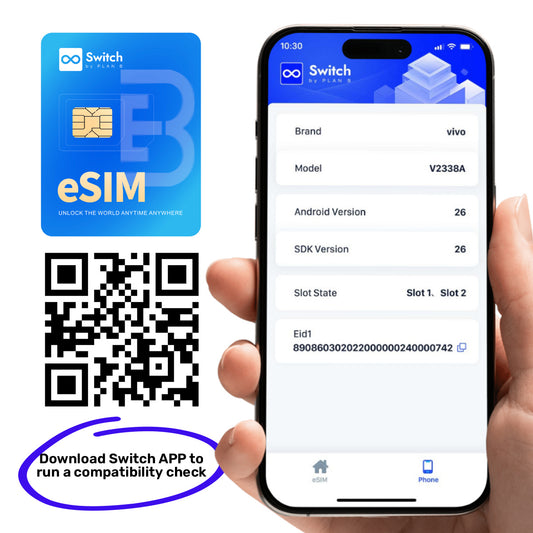
Switch's clearest advantage in 2026 is a defined product category: a physical eSIM adapter card. That matters when you want to use eSIM profiles with a device that has a physical SIM slot but lacks a usable native eSIM setup. The adapter is not a promise that every phone with a SIM tray will work.
Check the exact model and regional variant before ordering. A physical slot can be present while another requirement blocks the intended setup. A carrier lock can restrict which network you use; an adapter does not remove that restriction. Network bands and the eSIM provider must also fit your intended destination and service.
Switch Pro is the Android-managed choice. Its documented management path uses Android, so confirm that you have an appropriate Android setup for loading and managing profiles. Do not infer from an adapter's physical shape that an iPhone can perform the same management steps.
For eSIM Prime, there is no verified device requirement to compare against that route. Choose eSIM Prime instead only after its own instructions confirm that your specific phone works and that its setup meets your preference not to use a physical adapter. That is a real distinction in purchase requirements, not a claimed eSIM Prime feature.
Switch Max defines an iPhone path, with limits
Switch Max is the Switch choice for a compatible iPhone with a physical SIM slot. The distinction is between using a configured card in that iPhone and loading or managing the profiles. Do not assume that installing the card gives the iPhone the same profile-management route as the Switch Android app.
If you cannot use Android for configuration, assess the reader-based loading path before buying a card. If your iPhone lacks a physical SIM tray, neither Pro nor Max fits that hardware route. Check the regional variant as well as the model name: the presence of a SIM tray is a requirement, not a detail to resolve after delivery.
There is no verified eSIM Prime iPhone workflow in the supplied information. Before choosing it for iPhone use in 2026, find its published compatibility requirements and activation steps. Confirm the model, regional variant and carrier-lock conditions rather than relying on the word iPhone in a comparison headline.
Switch's reader offers a separate loading method
The open-source Bluetooth reader changes the setup choice: it loads profiles onto an adapter card without requiring an Android phone for that loading step. The reader bundle listing states storage of up to 15 eSIM profiles. That is a stated listing capacity, not a verified claim about eSIM Prime or about every adapter configuration.
This route is useful when you want to prepare a card for a compatible iPhone or another supported device with a physical SIM slot but do not have an Android phone for profile loading. It adds a separate piece of hardware to the setup. Decide whether that extra step is acceptable before choosing it over a simpler route confirmed by another provider's instructions.
Do not equate profile storage with simultaneous network use. The listing's capacity describes profiles stored on the card; it does not establish how many lines your particular phone can use at once. There is no eSIM Prime capacity figure here, so this section establishes a Switch capability rather than a capacity victory over Prime.
Neither side gets an unsupported privacy win
Switch identifies its Bluetooth reader as open-source. That describes the reader's software approach; it is not, by itself, a statement about what information an app, carrier or data-plan provider collects. Check the relevant privacy terms and permissions for the exact setup you intend to use.
No eSIM Prime privacy model is supplied. A claim that either option collects less data would need comparable, current documentation from both sides. Privacy is a verification task in this comparison, not a scored win. The same rule applies to security promises: do not infer them from a product name or from the fact that a component is open-source.
Data plans are separate from the adapter decision
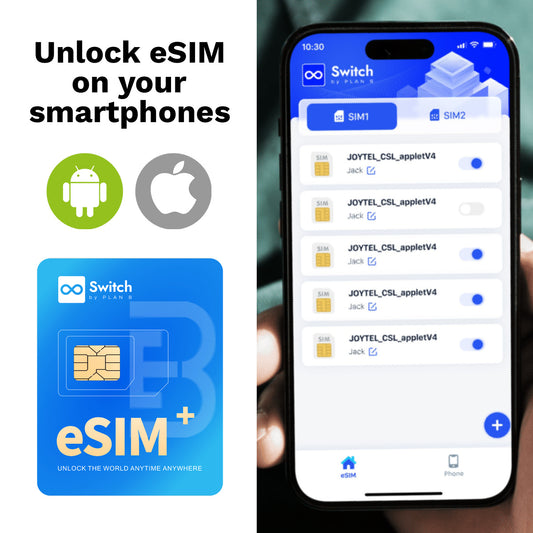
A Switch adapter is hardware for holding and using an eSIM profile. You still need a suitable profile and service for the destination and device. Switch also offers pre-loaded eSIM cards for iOS and Android, which change the setup path by pairing a card with destination data.
The supplied store listings include destination-data products named with 10GB and 20GB allowances and a 30-Day term. Those figures identify particular listed plans, not a universal allowance for Switch hardware. Confirm the destination, plan terms, activation requirements and your device fit for the specific card you consider.
No eSIM Prime plan description is supplied. Do not assume that it sells a data plan, provides adapter hardware or accepts a particular activation method without checking its published offering. If you have a prospective profile from any provider, confirm that its activation method works with the Switch loading route you intend to use. A QR code or manual activation detail matters only when the provider and card setup both support it.
Check the setup in this order
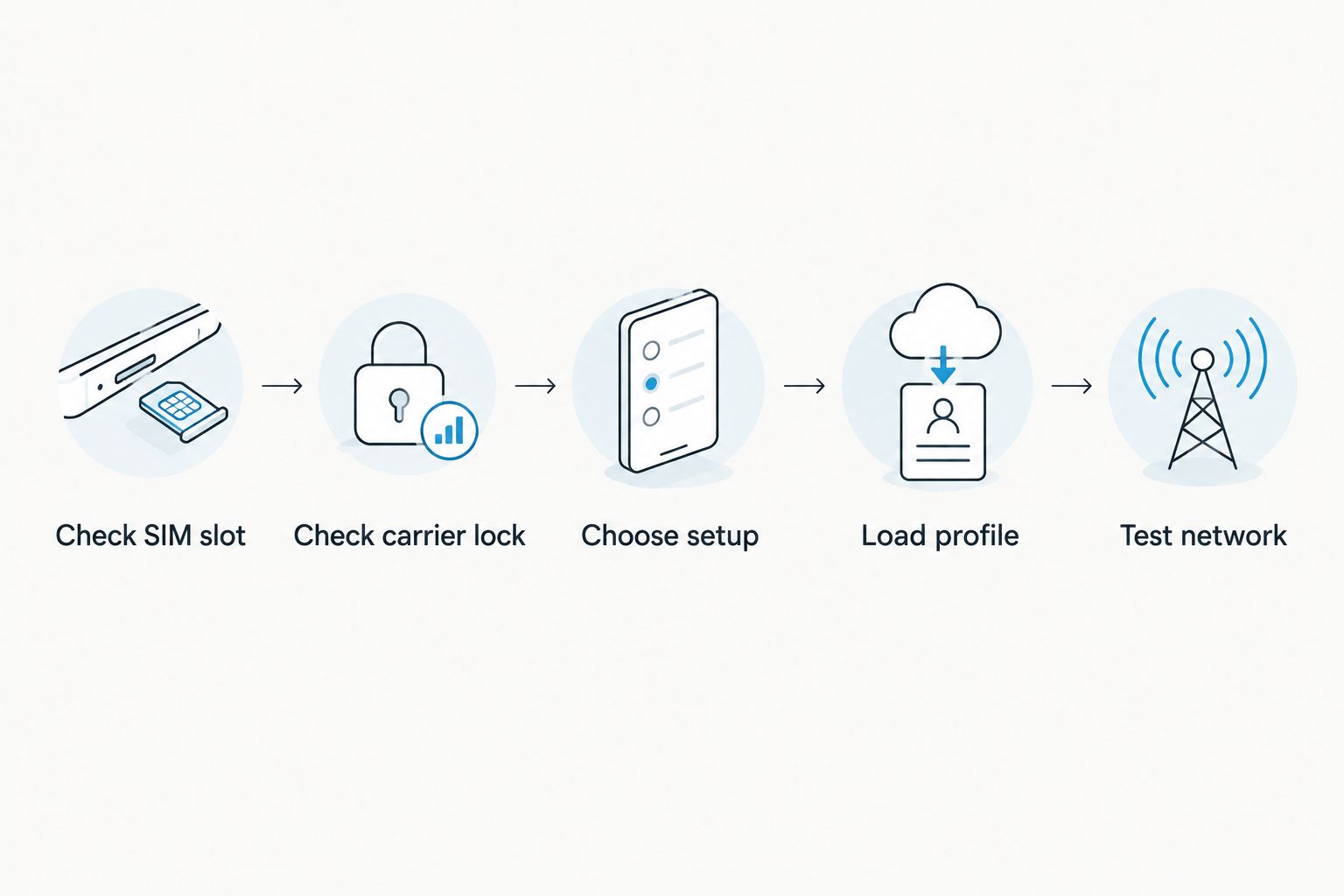
Use this checklist before choosing either name in 2026. It keeps the hardware decision ahead of plan selection.
- Check SIM slot. Confirm that your exact phone variant has a physical SIM slot if you want a Switch adapter. A model sold in another region is not proof about your device.
- Check carrier lock. Establish whether the phone accepts the network you intend to use. Do not purchase an adapter as a carrier-unlock workaround.
- Choose setup. Use the Switch Android management route for Pro, assess a configured Max card for a compatible iPhone, or choose reader-based loading when you need to provision without an Android phone.
- Load profile. Confirm the provider's activation method and the card's intended loading method before purchasing a destination plan.
- Test network. Verify the phone's network bands and the intended provider's service requirements for the destination.
If you cannot establish the first two checks, stop there. Profile capacity and destination-data choices do not fix a missing SIM slot or a restrictive carrier lock. If you are considering eSIM Prime instead, apply the same device-first discipline to its own published requirements; none are established by the information in this comparison.
Pricing: one known hardware category, one unknown model
Switch lists physical adapter hardware and also lists cards paired with destination data. That gives you two different types of purchase to compare: hardware for your intended profile-loading route, or a card with a specified data offering. Check the current listing for what is included. Do not treat a pre-loaded card and an unconfigured hardware choice as interchangeable.
The eSIM Prime pricing model is not documented here. It would be inaccurate to describe it as a subscription, a per-trip plan or a hardware purchase. Before comparing totals in 2026, identify what eSIM Prime actually sells, what the purchase includes and what additional service the device needs. A price comparison is meaningless until both sides cover the same requirement.
Final verdict
Choose Switch eSIM if: you are a frequent traveler or multi-SIM user who needs a documented physical adapter route, and your exact device has a compatible physical SIM slot. Choose Pro for Android-based profile management. Choose Max for use in a compatible iPhone after confirming how you will configure the card. Choose the reader route if you need to load profiles without an Android phone.
Choose eSIM Prime if: you want to avoid adding a physical adapter and its published product instructions confirm a route that supports your exact device, network and preferred setup. This is a conditional recommendation, not a claim that eSIM Prime offers a particular app, plan or feature. Its specifications must establish the win before you buy.
| Dimension | Winner |
|---|---|
| Documented physical adapter route | Switch |
| Documented Android management path | Switch |
| Documented compatible-iPhone card route | Switch |
| Documented loading without Android | Switch |
| Verified comparison of profile capacities | Not established |
| Privacy model | Not established |
| Pricing model comparison | Not established |
| No-physical-adapter requirement | eSIM Prime only if its published setup confirms it meets that requirement |
FAQ
What is the main difference in switch esim vs esim prime in 2026?
Switch eSIM has a documented physical adapter and Bluetooth reader range; eSIM Prime's product specifications are not supplied for verification. Compare the exact device requirements before treating the two as substitutes.
Does Switch Pro need a physical SIM slot?
Yes. Switch Pro is a physical adapter, so the target device needs a compatible physical SIM slot. Model, regional variant, carrier-lock status and network requirements still matter.
Can Switch Max be used in an iPhone?
Switch Max extends use to compatible iPhones with a physical SIM slot. Confirm the exact iPhone variant and how the card will be configured before purchase.
Can the Switch Bluetooth reader load profiles without an Android phone?
Yes. Switch identifies its open-source Bluetooth reader as a way to load profiles without an Android phone. Confirm that your chosen card, device and provider fit the setup.
How many profiles does the Switch reader bundle list?
The Switch reader bundle listing states storage of up to 15 eSIM profiles. That does not establish how many profiles your phone can use simultaneously.
Is eSIM Prime better for phones without a SIM tray?
That is not established. Switch's physical adapter route requires a SIM slot; eSIM Prime's device requirements must be checked in its own published documentation before recommending it for a phone without one.
Which option has a better privacy model?
Neither has a verified privacy win in this comparison. Switch identifies an open-source reader, but comparable data-handling terms for both options are needed to judge privacy.
Which costs less in 2026, Switch eSIM or eSIM Prime?
A valid cost comparison is not available without verified eSIM Prime product and pricing terms. First establish whether you are comparing hardware, a card with destination data or another type of offering.
One last thing
Verify the SIM tray on the exact regional variant, not just the phone model. That single check can rule out the Switch adapter route before profile storage or plan selection enters the decision. If the tray is present, choose the loading path next; if it is absent, require documented proof that an alternative works on your device.