The Best eSIM Setup for Digital Nomads on Older or Rugged Phones
Share
Short answer: before buying anything, check two things — whether your phone supports OMAPI (Open Mobile API), and whether you have one SIM slot or two. An eSIM adapter card turns a non-eSIM phone into one that can load travel eSIMs, but the management app needs OMAPI to talk to the card, and older phones are the most likely to lack it. If you have two slots, put the adapter in one and keep your home SIM in the other. If you have one slot, you're choosing between your home number and travel data unless you add a pocket router. And whatever you do, don't delete a travel profile you might want back — most providers won't let you reinstall it.
Disclosure: Switch eSIM sells removable eUICC adapter cards. This article includes cases where an adapter is the wrong purchase. Claims we haven't tested ourselves are marked.
Why this problem hits nomads specifically
Four situations, and it's worth knowing which one you're in:
Older phones. Native eSIM went mainstream around 2018–2020. A perfectly good 2017 Android has no eUICC, and nomads keep phones longer because replacing hardware mid-trip is miserable.
Enterprise rugged phones. This is the sharpest case. Samsung's XCover line — the default choice for field and outdoor work — has no eSIM. One XCover 6 Pro owner: "all the USA based carriers are now switching over to eSIM only meaning that the Xcover 6 Pro doesn't support eSIM." A business buyer in the same thread reports testing across a fleet and finding it unsupported.
But not all rugged phones. Blackview and Ulefone's current Armor-class models do advertise eSIM plus physical SIM. If you bought rugged recently, check before assuming — dial *#06# and look for an EID. If an EID appears, you have a native eUICC and you may not need an adapter at all.
Carrier-locked or regionally restricted devices. eSIM hardware can be present but locked down, and some models ship without eSIM enabled depending on the market of origin. Samsung's own documentation warns: "Depending on the country of origin, eSIM may not be supported even if your device is listed above."
Do this first: the OMAPI check
This is the step that saves people money, and almost nobody mentions it.
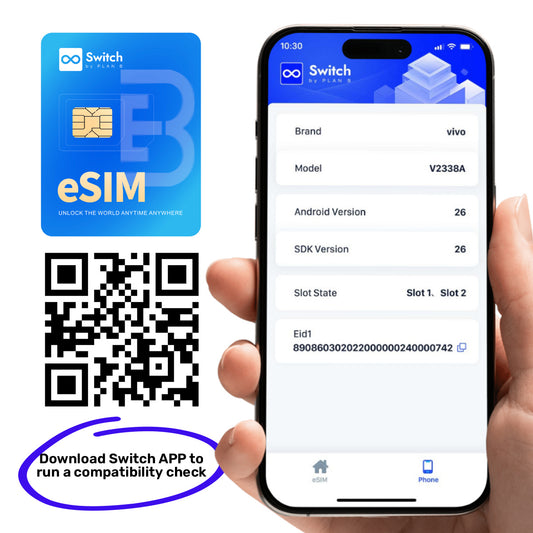
An adapter card is a smart card. To download profiles onto it, a management app on your phone has to send commands to that card — and on Android, that channel is the Open Mobile API. Without OMAPI, the app cannot write to or read from the card. As one Spanish-language technical guide puts it, you need an Android phone compatible with OMAPI "ya que no todos los terminales pueden gestionar los datos necesarios" — not all handsets can manage the necessary data — and without it "la app no podrá escribir ni leer perfiles en la SIM especial."
The irony worth internalising: the older and more obscure your phone, the higher the chance the adapter won't work with it. Budget rugged brands and old handsets are exactly where OMAPI support is patchiest. Check your specific model against the vendor's compatibility list before ordering — 5ber publishes per-model listings, and eSTK.me maintains its own.
One partial escape hatch. eSTK.me cards expose an on-card SIM Toolkit menu, reachable through the phone's built-in SIM Toolkit app rather than a third-party app. A documented walkthrough of that menu shows options including installed-profile count, free NVRAM, factory reset, ARA-M hashes and an "AAPL LPA Mode" for Apple devices without a native eUICC chip. STK is an old, near-universal standard, so this can work where OMAPI doesn't. We have not yet tested how much profile management is practical through STK alone on a low-OMAPI device — treat this as a promising route, not a guarantee.
The three architectures
Architecture A — Adapter as your only line (single-slot phone)
Adapter in the slot, travel profiles loaded onto it, switch as you cross borders.
- Works on: any single-slot phone that passes the OMAPI check
- Gives you: one active line at a time
- Costs you: your home number, while the travel profile is active
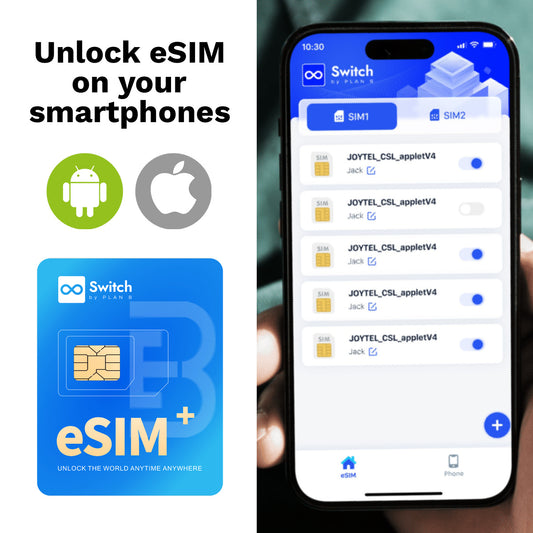
The hard limit: an adapter holds many profiles but runs one. 5ber's documentation is explicit — up to 15 profiles stored, "you can only activate one eSIM profile at a time." That's not a bug, it's the architecture. [We explain why in our piece on MEP and dual-SIM behaviour.]
Best for: nomads who've already moved their home number to a messaging-first or VoIP setup and genuinely don't need it ringing.
Architecture B — Adapter plus home SIM (dual-slot phone)
Home SIM in slot 1, adapter in slot 2. Home number stays reachable for calls and SMS 2FA; adapter carries local data and rotates by country.
- Works on: dual-slot phones — check whether slot 2 is shared with microSD
- Gives you: two lines live simultaneously
- Costs you: your microSD card, on hybrid trays
This is the setup I'd recommend to most long-term travellers. The bank-SMS problem is the one that actually ruins trips, and this solves it. Rugged phones are disproportionately likely to have two real slots plus a separate microSD, which works in your favour here.
Variant: if your phone has a native eSIM and a tray, put travel profiles on the native eSIM and skip the adapter. Cheaper, and you get the phone's own management UI.
Architecture C — Pocket router carries data, phone keeps its number
Home SIM stays in the phone. A separate mobile hotspot handles local data; laptop and phone connect over Wi-Fi.
- Gives you: connectivity that doesn't touch your phone's configuration; one connection shared across devices; no OMAPI dependency at all
- Costs you: a device to carry and charge
This is the most robust option for anyone whose income depends on being online, because it decouples "my phone works" from "my internet works." If the router dies you still have a phone; if the phone dies you still have internet for the laptop.
Unverified: I ran out of research budget before confirming which current hotspot models accept eSIM profiles versus physical SIM only, and whether adapter cards work reliably in router SIM slots. Router modems handle SIMs differently from phone modems and I won't guess. Do not buy a router on the strength of this section until we've published tested models.
Recommended setup by trip length
| Trip | Recommendation | Reasoning |
|---|---|---|
| Under 3 weeks, one country | Single travel eSIM or local SIM | An adapter is overkill for one profile |
| 1–3 months, one region | Architecture B with a regional plan | One profile covers the whole region; home number stays live |
| 3–12 months, multi-region | Architecture B, buy new profiles rather than deleting old ones | See the reinstall warning below |
| Indefinite, income depends on uptime | Architecture C plus B | Redundancy across two devices |
| Single-slot phone, any duration | Architecture C, or A if you've genuinely retired your home number | Don't give up SMS 2FA by accident |
| Phone fails the OMAPI check | Architecture C, or a new phone | An adapter will not work; this is the one case where we'd tell you not to buy ours |
The reinstall trap — read this before you delete anything
The obvious nomad strategy is rotating profiles: load Thailand, delete it, load Vietnam. That strategy can permanently destroy plans you've paid for.
Airalo's own help documentation:
"No, eSIMs typically can't be reinstalled. We highly recommend you don't remove any eSIM that you still intend to use. Once an eSIM is removed from your device, you may encounter an error when trying to download it again."
Ubigi is more generous and says so pointedly:
"All Ubigi eSIM profiles can be re-installed up to 5 times max after being deleted (NB: other providers usually allow the installation only once and re-installation is not possible)."
| Provider | Reinstall policy (as published) |
|---|---|
| Airalo | Generally not reinstallable; remove and it may be gone |
| Ubigi | Up to 5 reinstalls, profile must be deleted from the first device first |
| Others | Assume one install only unless their docs say otherwise |
Practical rules:
- Disable, don't delete. Disabling keeps the profile on the card. Note that validity keeps running while disabled — Airalo warns the validity period is not paused.
- Only delete profiles that are fully expended and expired.
- Plan card capacity as a budget. Fifteen slots across a year of travel is generous; across three years of monthly hops it isn't.
- Check reinstall policy before you buy, not after.
Which travel eSIM providers work with an adapter
Honest framing: no major travel eSIM provider certifies removable eUICC adapters, and none lists them as supported hardware. Anyone claiming a definitive compatibility list is guessing. What I can tell you is the mechanism that determines whether it'll work.
Look for manual activation-code install. Airalo documents three install methods — Direct, QR code, and Manual, where you're given an SM-DP+ address and an activation code to enter by hand. That manual path is what adapter management tools consume. A provider that only supports in-app "Direct" install on a native eSIM, with no retrievable activation code, is the risky case.
Before buying a plan, confirm you can get: the SM-DP+ address, the activation code, and a confirmation code if applicable. If those are visible in the provider's app or dashboard, the profile is very likely installable on an adapter.
One useful side note: Airalo explicitly allows buying an eSIM even on a non-compatible phone — "you'll have the option to share the eSIM to another device, rather than install it on your phone." That share flow is a legitimate way to get an activation code you can use elsewhere.
Unverified: we have not tested specific provider profiles on specific adapter cards. That test matrix is next.
Limitations, stated plainly
- One active line per adapter, regardless of stored profiles.
- OMAPI dependency — and the phones most likely to need an adapter are the most likely to lack it.
- No provider guarantees adapter compatibility. You're outside everyone's supported configuration. Support may decline to help.
- Deleting a profile can be irreversible.
- Hybrid trays force a choice between a second line and your microSD.
- A physical card can be lost. Its whole advantage is being removable; that's also its failure mode. Nothing is recoverable from a lost card.
- Carrier locks. An unlocked phone is required. An adapter doesn't defeat a carrier lock.
- Voice and SMS on travel data plans are frequently data-only. If you need a real number, that's Architecture B.
Our testing status
Published so far: nothing device-specific. In progress, and what we'll publish per device — OEM, model, Android version, OMAPI availability, tray type, whether the management app detects the card, whether an Airalo/Ubigi profile installs via manual activation code, and whether two lines register simultaneously in Architecture B. Priority devices: Samsung XCover 4s/5/6 Pro, a pre-2018 mainstream Android, and a current Blackview or Ulefone Armor for the native-eSIM comparison.
Results will replace the unverified markers above. Until then those markers stay.
Sources: Airalo help centre (installation methods; reinstall policy; non-compatible device purchases) · Ubigi help centre (reinstallation limits and device transfer) · 5ber help pages (profile capacity; one active profile) · eSTK.me STK menu documentation · Samsung eSIM compatibility pages and Samsung EU community threads on XCover eSIM support · Blackview and Ulefone product pages · AOSP SIM Toolkit documentation · androidayuda.com on OMAPI requirements for eUICC adapter apps
Learn more:
- What triple SIM mobile phones are available in 2025?
- Rugged Phones with eSIM – Blackview Official Store
- The Ultimate Rugged Smartphone with 64MP Night Vision Camera and 10600mAh Battery – Ulefone Global
- eSIM Supported Rugged Smartphones – Blackview Official Store
- Ulefone Armor 29 Ultra Rugged Phone – 5G, 21200mAh, Night Vision
- Premium Flagship Rugged Smartphones – Ulefone Global
- Xcover 6 Pro no eSIM
- Which Galaxy Phones Support an eSIM?
- Galaxy eSIM and supported network carriers
- Galaxy eSIM and supported network carriers
- wikipedia.org
- Xcover pro 6 SIM/ESIM/SD card
- Comment utiliser une eSIM Airalo
- How To Install and Activate an Airalo eSIM
- How do I install and set up an eSIM on my iOS device?
- Come installare e attivare una eSIM Airalo
- https://www.airalo.com/
- Airalo eSIMのインストール&アクティベート方法|設定ができない時の解決策も紹介
- Can I reinstall an eSIM?
- I get an error message when I use the QR code on my Ubigi account to re-install my Ubigi eSIM profile, why?
- Can I reinstall an eSIM?
- Posso reinstallare una eSIM?
- How to reinstall the Ubigi eSIM profile I deleted on my iPhone/iPad?
- How to install my current Ubigi eSIM profile in a new/another Android device to keep my Ubigi account?
- eSTK.me SIM Tool Kit Menu 日本語訳、そんなに深く使う部分はそんなにないけど作成。 · GitHub
- Cómo usar eSIM en móviles que no la soportan
- Sim Toolkit Application (STK)
- 5ber eSIM Card
- How do I access Android STK Menu using APK?
- Rojeets/Simtoolkit · GitHub