Using an eSIM Adapter in China, Japan and the EU: Country Rules That Trip People Up
Share
Short answer: for most countries, an adapter card behaves exactly like a built-in eSIM and no country-specific rules apply. Three situations break that. First, China — install every profile you need before you arrive, because inside the country you may not be able to reach your provider or download the app that manages your card. Second, anywhere requiring identity verification, which affects local SIMs and voice-capable lines but not, for now, data-only travel eSIMs. Third, Europe — if you live in the EU/EEA, your existing phone plan already covers you and buying a travel eSIM is usually wasted money.
The single rule that covers all three: load your profiles before departure, on Wi-Fi, at home. For adapter cards this isn't general good advice — it's the difference between working and stranded, for reasons specific to how adapters manage profiles.
Disclosure: Switch eSIM sells eUICC adapter cards. Where a country's rules make an adapter a bad choice, this page says so.
Why adapters are different from built-in eSIMs abroad
Three constraints from earlier in this series, because they drive everything below.
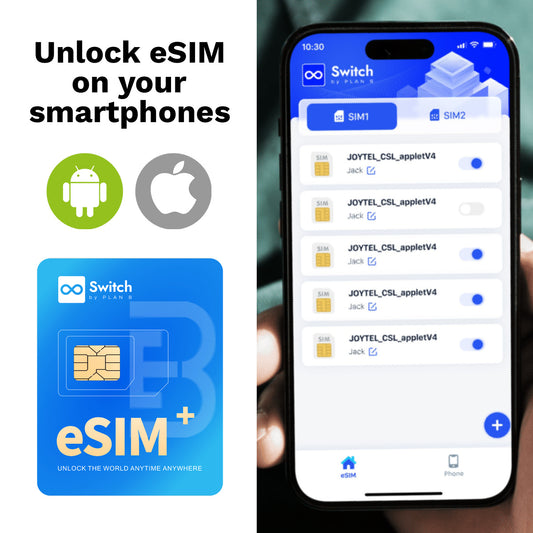
An adapter card's profiles are managed by its companion app, not your phone's Settings. Downloading, enabling, disabling or deleting a profile generally requires that app, a working data connection, and a supported Android device. A profile that's already enabled will usually keep working if you move the card to another phone — but you can't change anything without the app.
So the adapter's dependency chain abroad is longer than a native eSIM's: network → app store → app → provider's servers → profile. A built-in eSIM needs only the last two, through the phone's own system installer. Every extra link is a place a country's rules or a national firewall can cut the chain.
This is why "install before arrival" is a hard requirement for adapter users and merely sensible advice for everyone else.
China
The situation as of [DATE]. MIIT approved nationwide eSIM commercial trials for smartphones on 13 October 2025, and China Mobile, China Unicom and China Telecom all began offering eSIM service within days. Activation requires in-person identity verification at a carrier store — China Unicom takes online appointments but still requires physical ID checks. Chinese citizens use a national ID; foreign residents can generally register with a passport plus residence permit. Short-term visitors cannot use domestic carrier eSIMs. That hasn't changed with the approval.
Why the adapter market exists here. Apple states that in China mainland only iPhone 17e and iPhone Air support eSIM — and Apple's own guidance notes that in Hong Kong and Macao certain iPhone models ship with two nano-SIM trays instead. A phone bought in mainland China, Hong Kong or Macao is far more likely than a European or US model to have no usable eSIM at all. If you own one and want travel eSIM pricing, an adapter card is one of very few routes. This is the strongest legitimate use case in this article.
How travel eSIMs actually connect. A travel eSIM for China roams on one of the big three carriers. Because it's international roaming, your data is routed out of mainland China — typically via Hong Kong, Singapore, or the provider's home network — before reaching the internet. The practical consequence widely reported by users is that services behave as they do at home. A locally-registered Chinese SIM routes through domestic infrastructure and behaves differently.
Two honest caveats. This is a property of how roaming is routed, not a product feature, and no provider controls it end to end. At least one source describing the mechanism qualifies it as "yes, sometimes — but not guaranteed." Routing arrangements can change. Don't build a trip around it, and don't assume a provider advertising a "built-in VPN" is offering anything different from ordinary roaming.
The adapter-specific trap, which is the reason this section exists. Reaching your provider's website, app or account from inside China may not be possible. Google Play is not available in mainland China. If you land with no profile installed on your card, you may face all of: no data, no way to reach the provider, and no way to install the app that manages the card. A native eSIM user in the same position has a slightly better chance, because their phone's system installer can sometimes reach provisioning servers directly. An adapter user has no such fallback.
⚠️ Unverified and important: whether SM-DP+ provisioning traffic is reachable from inside mainland China on a local network is something I could not confirm. Treat it as unavailable until we've tested it. This is the highest-priority test in this article.
A further complication worth flagging. One report on the China-market iPhone Air says the domestic model carries a geofencing mechanism preventing international eSIMs from being added while the user is inside China — requiring them to physically leave the country to add one — and limits the device to two eSIM profiles against eight on international versions. The same source notes conflicting reports on this point, so treat it as unconfirmed. If accurate, it's a genuine hard stop for China-market phones, and it doesn't affect adapter cards, since an adapter is a physical card in a tray rather than the phone's embedded eUICC. That's a meaningful advantage — but I'm not willing to claim it before testing.
What to do:
- Install and test every profile you need before you fly. Test at your departure airport, not on arrival.
- Install your adapter's companion app before you go, and confirm it opens.
- Enable data roaming for the profile. A roaming eSIM will not connect without it.
- Keep a second working profile on the card as a fallback. Storing several is the adapter's main advantage — use it here.
- Expect no Chinese +86 number. Travel eSIMs are data-only, which matters if a local service needs SMS verification.
Japan
Japan's rules split cleanly along one line: data or a phone number.
Data-only travel eSIMs: currently no identity verification. Buy online, install at home, activate on landing. KDDI's povo states its data-only plan is eSIM-only, doesn't support calls or SMS, and can be opened without identity documents. This is the normal tourist path and it works fine with an adapter, provided you install before departure.
One catch worth knowing: povo's own data-only procedure page says that while no ID document is needed, you do need an email address and a contact phone number in Japan able to receive an SMS one-time password. A tourist with no Japanese number can't complete that. Foreign-issued travel eSIMs don't have this problem — but a Japan-domestic data plan may.
A Japanese phone number: identity verification, and it's got harder. Voice-capable service is regulated under the Act on Prevention of Unauthorized Use of Mobile Phones, and providers can't simply email you a profile. Mobal is unusually clear about why: "Japan has strict regulations about voice eSIM services, so we need to make sure you're the real owner… we can't just send you the eSIM by email" — it posts an access code to the address on your ID, or you collect it in person with ID. Their data-only eSIMs, by contrast, arrive by email in minutes with no ID.
From 1 April 2026, online verification tightened further. Amendments to the enforcement regulations largely abolished the old method of uploading a document photo plus a selfie for online contracts, moving to IC-chip reading of a My Number card, driver's licence or residence card. KDDI/povo changed its method from 25 March 2026 and Rakuten Mobile from 30 March 2026. Practical effect: getting a Japanese voice line online without Japanese documents is now very difficult. If you need a Japanese number, plan on in-person collection or a provider that mails an access code.
Adapter-relevant good news: Mobal's "eSIM Access Code" flow is a manual activation code, and per the compatibility work in this series, a manual code is exactly what an adapter can consume. A provider that mails you a code is more adapter-friendly than one that installs through its own app. [VERIFY against Mobal's documentation before stating this as fact.]
⏳ Pending change — data-only registration. In March 2026 Japan's cabinet approved a bill extending identity-verification requirements to data-only SIM cards, reported to include short-term foreign visitors presenting passports, plus a provision limiting how many lines one person can hold. Reporting indicates it takes effect April 2027 if passed by the Diet. It is not in force now.
Two things are unclear and I'm not going to guess: whether the requirement reaches foreign-issued travel eSIMs roaming in Japan as opposed to SIMs issued by Japanese carriers, and the final scope after passage. My reading is that it targets SIMs issued in Japan — but that's inference, not sourcing. Flagged for re-check in Q1 2027.
The EU and EEA
If you live in the EU/EEA, read this part first, because it may save you the purchase.
Roam-like-at-home has applied since 15 June 2017 and is now set out in the recast Regulation (EU) 2022/612, which extended it to June 2032. If you hold a domestic mobile subscription from an EU member state, Iceland, Liechtenstein or Norway, you use your existing calls, texts and data allowance at domestic prices anywhere in the EU/EEA. The Commission's guidance goes further: RLAH is meant to include comparable quality — speed, and 5G access if you have 5G at home.
So for an EU/EEA resident travelling inside the EU/EEA, a travel eSIM is usually redundant, and an adapter card definitely is. We sell adapters; that's still the honest answer.
Where RLAH doesn't reach — the actual trip-ups:
- Non-EU residents get nothing from RLAH. It's a right attached to EU/EEA domestic subscriptions. A travel eSIM bought by a visitor from outside the EU is an ordinary commercial roaming product. Its coverage is whatever the provider's contract says.
- The UK is out. RLAH stopped applying when the UK left the single market on 1 January 2021. Some operators voluntarily maintain it — the Commission's advice is to check with your operator before travelling.
- Switzerland is neither EU nor EEA, so RLAH doesn't apply there either. It's one of the most common gaps in plans marketed as covering "Europe."
- Fair use has a four-month rule. RLAH is for periodic travel. If you spend more time roaming in another EU country than at home across a four-month period, your operator may contact you and apply a surcharge. This is the one that catches long-stay travellers and remote workers, not tourists.
- Recent extensions. RLAH was extended to Ukraine and Moldova from 1 January 2026. A separate regional regime has covered the Western Balkans since 2021, and the Commission has proposed negotiations with Albania, Bosnia and Herzegovina, Kosovo, Montenegro, North Macedonia and Serbia.
Why regional travel eSIM plans still usually beat single-country ones — for non-EU visitors, and it isn't about RLAH. A regional plan is one profile covering a multi-country itinerary; a local plan may not roam outside its home country at all. For adapter users specifically, one regional profile means one install before departure and no profile switching mid-trip, which is exactly where adapters are weakest. Check the covered-country list against your actual itinerary — particularly Switzerland, the UK and Turkey.
Country rules table
| Country / region | Install before arrival? | Registration required? | Adapter-specific notes |
|---|---|---|---|
| China mainland | Essential | Domestic carrier eSIM: in-person ID, tourists excluded. Travel eSIM: none | Provider sites and Google Play may be unreachable inside the firewall. No app = no profile management. Whether provisioning servers are reachable is untested. Most valuable adapter market (China-market phones often lack eSIM) and the highest-risk one |
| Hong Kong / Macao | Recommended | None for travel eSIM | Apple notes certain models here ship dual nano-SIM with no eSIM — check your specific model. Separate network from mainland; confirm your plan covers both if crossing |
| Japan | Recommended | Data-only: none currently. Voice/number: yes, and stricter since 1 April 2026 | Providers issuing a mailed access code are adapter-compatible; app-only installs are not. Data-only registration bill pending, reported April 2027 |
| South Korea | Recommended | Local SIM: reportedly tightened for inbound visitors in early 2026. Travel eSIM: none | [VERIFY — single secondary source] |
| Singapore | Recommended | Local SIM: passport registration mandatory. Travel eSIM: none | [VERIFY — single secondary source] |
| EU / EEA | Recommended | None | EU/EEA residents: your own plan already covers you. Non-residents: check the country list |
| UK, Switzerland, Turkey | Recommended | None | Frequently excluded from "Europe" plans despite being in Europe. Check before buying |
| Ukraine / Moldova | Recommended | None | RLAH extended to both from 1 Jan 2026 — relevant to EU residents, not to travel eSIM buyers |
Rows marked [VERIFY] rest on a single secondary source and shouldn't be cited until confirmed against a primary one.
Pre-departure checklist
Run this at home, on Wi-Fi, with time to fix problems.
- Confirm your phone is carrier-unlocked. Nothing else here helps if it isn't.
- Install your adapter's companion app and open it. Before you leave the country where you can download it.
- Install every profile you'll need for the whole trip. Not just the first country. Storage is finite — check your limit.
- Enable the profile you'll land on and load a web page. Actually test it.
- Turn on data roaming for that profile. Roaming eSIMs won't connect without it.
- Screenshot every activation code and save it offline. Most are single-use, and some providers remove install details from their app once installation is detected.
- Note your APN settings if the provider specifies one.
- Check your itinerary against the plan's country list. Switzerland, the UK, Turkey.
- China only: test at the departure airport, and keep a second profile on the card as fallback.
- Japan only: if you need a Japanese number, arrange it weeks ahead — mailed access code or in-person collection.
Limitations
- Nothing here has been tested on our hardware. This is a documentation-based regulatory summary. The China install-inside-the-firewall question is unresolved and is the most consequential gap.
- Two claims rest on single or weak sources: the iPhone Air geofencing report (whose own source notes conflicting accounts), and the Korea/Singapore rows.
- Regulatory content decays fast. China's position changed in October 2025; Japan's verification methods changed in April 2026; Japan's data-only rule may change in April 2027. Re-check dates.
- I've deliberately not quantified Great Firewall behaviour. The available sources are vendor marketing and the mechanism isn't guaranteed.
- Adapter cards remain Android-only per earlier findings, carried forward.
Learn more:
- China Network Coverage Guide (2026)
- Apple Spearheads a New Era for Smartphones
- iPhone Air pre-orders set to begin in China following eSIM a
- Why the Apple eSIM-Only iPhone China Works Differently in Mainland China
- China eSIM News 2025: 7 Tested Travel Plans and Setup Tips That Actually Work
- China Finally Dips Its Toe Into the Smartphone eSIM Waters
- Is eSIM Legal in China in 2026 or Still Banned for Foreigners?
- The Roam Index — eSIM device compatibility reference for travellers
- Best eSIM for Hong Kong and China 2026 (No Apps Blocked)
- VPN Myths & Great Firewall Explained
- A 2026 Guide for International Travelers
- Bypass the Firewall & Stay Connected
- Can I Use International Roaming or Hotspot to Bypass the Firewall in China? (Guide)
- Contourner le Grand Pare-feu sans VPN : méthode eSIM (2026)
- 2026 China Travel eSIM Buying & Activation Guide
- Best eSIM for China 2026 to Bypass the Firewall
- Japan to require ID checks for data-only SIM cards amid fraudulent use
- Which is the Best Options Instead 2026
- How to Get a Japanese Phone Number Without a Residence Card — Hello World Japan
- 【2026年最新版】日本一時帰国でおすすめのeSIM7選|電話番号は必要?海外在住者向けに徹底解説
- ESIM
- Free eSIM Asia 2026: Best Trial for Japan, Korea, Thailand and Singapore
- Which One Should You Get? — Hello World Japan
- eSIM Japan: Best eSIM with Japanese Phone Number
- 52025DC0324
- Roaming: Review of the fair use policy and the sustainability derogation
- Roaming: collegato ovunque nell'UE senza costi aggiuntivi
- Roaming: Review of the fair use policy and the sustainability derogation
- https://data.consilium.europa.eu/doc/document/ST-10696-2025-INIT/en/pdf
- Roaming Regulation
- https://eur-lex.europa.eu/legal-content/EN/TXT/PDF/?uri=CELEX:52025DC0324
- Shaping Europe’s digital future
- Notice Regarding Changes to Identity Verification Methods for New Contracts Due to Ministerial Ordinance Revisions
- Second-Generation Residence Card & Specified Residence Card in Japan
- マイナ取得義務化は見送り|スマホのオンライン契約は既に"実質必須"に【2026年改正】
- Japan to require ID checks for data-only SIM cards amid fraudulent use
- Japan to Make KYC Mandatory for SIM Issuance
- Japan's April 2027 IC-Chip Verification Mandate Explained
- The app you need before you land in Japan
- (Updated) Important Notice of Change in Identity Verification Method for Online Applications