What Is an eSIM Adapter? How Physical eSIM Cards Work (2026)
Share
An eSIM adapter is a nano-SIM-sized card containing a removable eUICC chip. You insert it into your phone's normal SIM slot, and it lets a device without built-in eSIM support download, store and switch between multiple eSIM profiles — typically 5 to 50, depending on the card's storage.
It is not a data plan, and it is not a travel SIM. It is empty hardware. You bring your own eSIM profiles from whichever provider you like.
At a glance
| What it is | Removable eUICC in a 4FF (nano-SIM) card body |
| What it does | Adds eSIM profile storage to a phone that lacks native eSIM |
| Typical price | $9–$70 one-time, hardware only |
| Profiles stored | 5–50+, limited by on-card storage in KB |
| Works on Android | Yes, if the device exposes OMAPI, or with an external reader |
| Works on iPhone | Only via an external card reader |
| Governing standards | GSMA SGP.21 / SGP.22 (Remote SIM Provisioning) |
What is an eSIM adapter, exactly?
An eSIM adapter is a eUICC in removable form. To understand why that isn't a contradiction, you need to separate two things that most people treat as one.
A SIM card is two things at once: a physical card body, and a secure chip inside it.
The chip is a UICC (Universal Integrated Circuit Card) — a tiny tamper-resistant computer running a Java Card operating system. In a traditional SIM, one carrier profile is burned onto that chip at the factory. It is fixed. To change carriers, you change the card.
An eUICC (embedded UICC) is the same class of chip with one crucial addition: it can accept new carrier profiles over the air, after manufacture, and hold several at once. That capability is what "eSIM" actually means. It is a provisioning capability, not a shape.
The confusion comes from the "e". Most people read it as "embedded" and assume eSIM = soldered to the motherboard. Soldering is just the most common packaging (the MFF2 form factor). Nothing in the GSMA specifications requires an eUICC to be permanently attached.
So an eSIM adapter puts an eUICC into a card body you can pull out. The chip supports the same GSMA Remote SIM Provisioning standard as the eSIM in an iPhone 16. It just sits in your SIM tray instead of on your logic board.
The developers of OpenEUICC, the leading open-source profile manager for these cards, put the point plainly when asked whether removable eSIMs are a joke:
"No, even though the name 'removable embedded SIM' can sound like an oxymoron. In fact, there can be many advantages to these chips compared to fully embedded ones. For example, the ability to transfer eSIM profiles without carrier support or approval, or the ability to use eSIM on devices that do not and may never get the support, such as Wi-Fi hotspots."
UICC vs eUICC vs eSIM adapter
| Traditional SIM (UICC) | Built-in eSIM (eUICC, MFF2) | eSIM adapter (removable eUICC) | |
|---|---|---|---|
| Profiles held | 1, fixed at factory | Multiple | Multiple |
| Can download new profiles | No | Yes | Yes |
| Physically removable | Yes | No | Yes |
| Occupies SIM tray | Yes | No | Yes |
| Move to another phone | Yes | No — reissue required | Yes |
| Needs carrier permission to move | No | Usually yes | No |
| Uses SIM slot | Yes | No | Yes |
What form factor is an eSIM adapter?
Almost all eSIM adapters ship in 4FF (nano-SIM) form, usually with a stepped tray or plastic frames so the same card fits 3FF and 2FF slots.
This table is the reference most explanations of this category skip:
| Form factor | Name | Dimensions | Introduced | Standard | Profile provisioning |
|---|---|---|---|---|---|
| 1FF | Full-size | 85.6 × 53.98 × 0.76 mm | 1991 | ISO/IEC 7810 ID-1 | Fixed at manufacture |
| 2FF | Mini-SIM | 25 × 15 × 0.76 mm | 1996 | ISO/IEC 7810 ID-000 | Fixed at manufacture |
| 3FF | Micro-SIM | 15 × 12 × 0.76 mm | 2003 | ETSI TS 102 221 | Fixed at manufacture |
| 4FF | Nano-SIM | 12.3 × 8.8 × 0.67 mm | 2012 | ETSI TS 102 221 v11.0.0 | Fixed at manufacture |
| MFF2 | Embedded eSIM | 6 × 5 mm, soldered | 2016 | JEDEC SON-8 / ETSI TS 102 671 | Remote (GSMA SGP.22) |
| 4FF + eUICC | eSIM adapter | 12.3 × 8.8 mm | ~2020 (commercial) | ETSI 4FF body + GSMA SGP.22 | Remote (GSMA SGP.22) |
The last row is the whole product category: a 4FF body from 2012, carrying a chip capable of the 2016 provisioning standard.
The relevant specifications are GSMA SGP.21 (RSP Architecture) and GSMA SGP.22 (RSP Technical Specification, currently v2.7, published 24 April 2026). Both are freely published by the GSMA. Neither mandates a soldered chip, which is why compliant removable eUICCs exist.
How is an eSIM adapter different from a travel SIM or a built-in eSIM?
This is the single most common misunderstanding, so it's worth being blun: an eSIM adapter contains no data and no phone number when you buy it.
| eSIM adapter | Travel SIM / travel eSIM | Built-in eSIM | |
|---|---|---|---|
| What you're buying | Empty hardware | A data plan | A capability in the phone |
| One-time or recurring | One-time | Per trip / per plan | Included in phone price |
| Provider choice | Any provider you like | That provider only | Any provider |
| Reusable across trips | Yes, indefinitely | No | Yes |
| Requires compatible phone | No — that's the point | Yes, for eSIM versions | Yes |
| Typical cost | $9–$70 once | $4–$60 per trip | $0 |
The practical relationship: an eSIM adapter is the container, a travel eSIM is the contents. If your phone has no native eSIM, you need the container before the contents are of any use to you.
How does the adapter get profiles onto the card?
An eSIM profile is downloaded from an operator's SM-DP+ server (Subscription Manager – Data Preparation+) by a piece of software called an LPA (Local Profile Assistant). You supply the LPA with an activation code or QR code; it authenticates, retrieves the bound profile package, and installs it onto the eUICC.
On a phone with built-in eSIM, the LPA is baked into the operating system — that's the "Add eSIM" screen in Settings. An adapter card can't use that LPA, because the OS only points it at the internal chip. So the adapter needs its own route to the chip. There are three.
Route 1: On-device app via OMAPI (Android only)
Android exposes OMAPI (Open Mobile API), which lets an app send APDU commands directly to a secure element in the SIM slot. A vendor's app acts as the LPA and talks to the card through OMAPI.
There's a gatekeeper. Android's Access Control Enforcer will only permit this if the card's ARA-M (Access Rule Application Master) contains the certificate hash of the app requesting access. In other words, the card must be manufactured to explicitly authorise that specific app. This is why cards and apps are usually paired, and why a card from one vendor often won't work with another vendor's software.
Two practical constraints follow:
- OMAPI availability is inconsistent. Support varies by Android version, chipset and OEM firmware. Some phones marketed as compatible simply don't expose it.
- Vendor-locked ARA-M means vendor-locked cards. Unless the card also authorises open software such as EasyEUICC or NekokoLPA, you are dependent on one company's app.
Route 2: External card reader (Android, iOS, desktop)
Take the card out of the phone, put it into a reader, and manage profiles from there. Two kinds exist:
- PC/SC readers — standard smart-card readers, connected to a computer or an Android device via USB
- Bluetooth / eLPA readers — battery-powered readers that pair with a phone wirelessly
Readers bypass OMAPI completely. The reader talks to the chip; your phone or computer talks to the reader. Nothing depends on your handset's firmware.
This is the only route that works on iPhone. iOS provides no public API for third-party apps to send APDUs to the SIM slot, and Apple's own eSIM interface addresses only the internal chip. An iPhone user without native eSIM has to use a reader — there is no app-only path, and any vendor claiming otherwise should be treated with suspicion.
Route 3: STK menu on the card itself
Some cards ship with a SIM Application Toolkit menu — a small application on the chip that surfaces inside your phone's own settings, usually under "SIM Toolkit". It lets you switch between profiles already on the card without any app or reader.
This is worth understanding precisely, because it's frequently oversold: STK menus generally let you enable, disable and switch stored profiles. Downloading a new profile still requires an LPA via Route 1 or 2. For an iPhone user, a card with a good STK menu means you need the reader only when adding a new plan, not every time you switch — genuinely useful, but not a replacement for the reader.
Which phones need an eSIM adapter — and which don't?
You probably don't need one if your phone is:
- iPhone XS, XR or newer (2018+) — native eSIM
- Samsung Galaxy S20 or newer, most Z Fold / Z Flip models
- Google Pixel 3 or newer
- Most flagship Androids from 2022 onward
If your phone has native eSIM, use it. It's free, better integrated, and doesn't consume your SIM tray. Buying an adapter for a phone that already supports eSIM is a waste of money.
An adapter makes sense if you have:
- iPhone X, 8, 7 or earlier — no eSIM hardware, and no software update will add it
- Mid-range and budget Androids — Galaxy A-series, Redmi, Realme, Moto G and similar frequently ship without eSIM even in 2026 models
- Rugged and industrial handsets — often built on older platforms
- Regional model variants — the same phone model sometimes has eSIM in one market and not another
- Wi-Fi hotspots, routers, tablets, trackers and IoT devices with a SIM slot but no eSIM stack
- Fleet hardware where you want carrier flexibility without redesigning the board
A useful diagnostic: eSIM support is hardware. If your phone lacks an eUICC, no app, update or setting will create one. Anything advertised as software that "unlocks eSIM" on unsupported hardware is not real.
To check your own device: on iPhone, look for an EID under Settings → General → About. On Android, dial *#06# and look for an EID alongside the IMEI. An EID means an eUICC is present. [Internal link: full compatibility checker →]
What are the trade-offs and limitations?
An honest account, because these matter more than the marketing:
It occupies your SIM slot. The adapter is a SIM card physically. On a single-slot phone, your original physical SIM has to come out. On a dual-slot phone you keep one slot free. Native eSIM has no such cost — this is the fundamental disadvantage of the whole category.
Dual-SIM behaviour is inconsistent. Native eSIM supports MEP (Multiple Enabled Profiles), letting several profiles run simultaneously on one chip. Removable eUICCs generally do not participate in MEP the way built-in chips do, so having two profiles active at once is not reliable. Plan on one active profile per card. [Internal link: MEP and removable eUICCs →]
Android's SIM-slot disabling bug. If you disable the adapter through your phone's SIM Manager, Android may mark that CardID disabled and refuse to re-enable it. eSIM.me documents this explicitly and instructs users not to disable the card that way. Use the vendor app or STK menu instead.
App and vendor dependency. Because ARA-M binds cards to specific software, a card is usually only as usable as its vendor's app. If that app is pulled from the store, or the vendor's servers go offline, the card can become difficult or impossible to manage. This isn't hypothetical: 5ber, once among the best-known brands, suspended operations, its backend went dark, and its Android app was removed from Google Play — leaving customers with hardware they couldn't provision. [Internal link: what happened to 5ber →]
Not every provider works. Profiles delivered app-only, with no QR code or activation code, generally can't be installed on an adapter. Some operators also apply Profile Policy Rules that restrict installation or deletion. Providers that issue a standard QR or LPA: activation string are the safe bet. [Internal link: tested provider compatibility →]
Carrier locking is separate. An adapter does not unlock a network-locked phone. A locked handset will reject profiles from other carriers whether they arrive by adapter or native eSIM.
Not for the impatient. Reader workflows, STK menus and APDU errors are more involved than tapping "Add eSIM". If you want zero friction and your budget stretches to a newer handset, native eSIM is the better experience.
When an adapter is the wrong choice: your phone already has eSIM; you need two lines active simultaneously; you're unwilling to install a companion app or carry a reader; or you're buying a new phone within a few months anyway.
Who makes eSIM adapter cards?
The category is small, and hardware often comes from a handful of secure-element makers — Kigen, Eastcompeace, Giesecke+Devrient and Thales among them — which is why unrelated brands sometimes behave identically. Prices and specifications below are as published at the time of writing and change frequently.
| Brand | Storage / profiles | Approx. price | iOS support | Notes |
|---|---|---|---|---|
| 9eSIM | V0 480 KB; V0 Max 1.1 MB; V3 1.5 MB / up to 50 profiles | $15–$24 | Via reader | STK menu switching; markets an open LPA approach; strong technical reputation |
| eSTK.me | 512 KB; Plus 1024 KB (13–26 eSIMs); Max 1600 KB (up to 60) | ~$9–$26 | Via reader | Works with open-source EasyEUICC; favoured by enthusiasts |
| eSIM.me | Up to 15 profiles, tiered by licence | €24.95–€69.95 | No | Licence model: SINGLE / MULTI / OMNI. Device transfer €10 unless on OMNI. Android only |
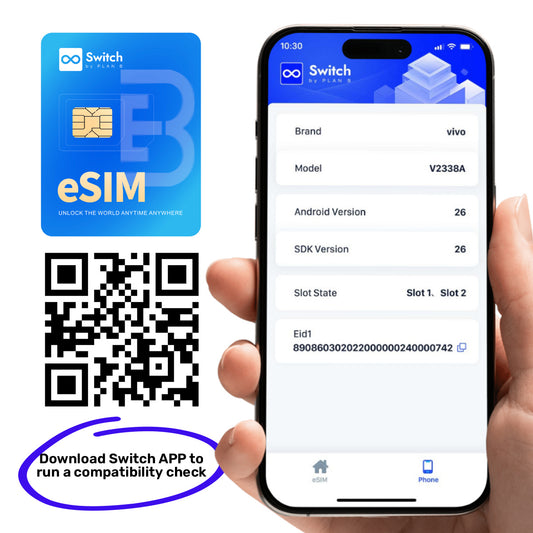
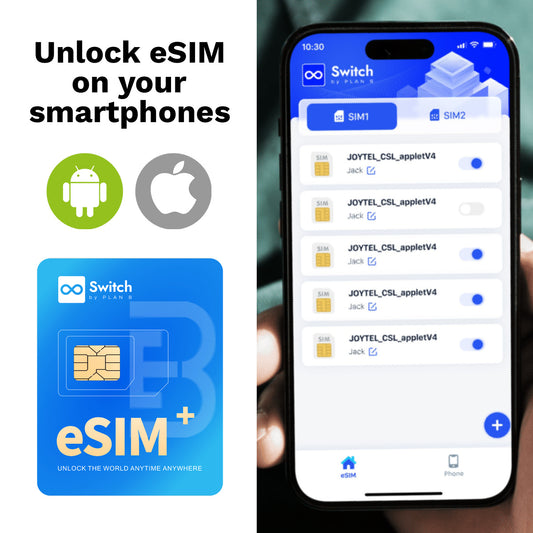
| Switch eSIM | Up to 15 profiles | ~$14–$21 | Yes, via reader | Pro (Android), Max (Android + iOS); open-source Bluetooth reader; bulk/IoT tier |
| EIOTCLUB | Varies | Varies | Limited | IoT and device-connectivity orientation |
| XeSIM | Eastcompeace hardware | Varies | Via reader | Relaunch by the former 5ber team. Some technical reviewers advise caution given the 5ber shutdown |
| 5ber | — | — | — | No longer operating. Servers offline, app delisted. Do not buy |
Two things to weigh that most comparison tables ignore:
Storage in KB matters more than the headline profile count. Capacity is fixed memory; profiles vary in size, roughly 20–80 KB depending on operator, applets and OTA keys. "Up to 50 profiles" assumes small ones. A 1 MB card loaded with large carrier profiles may hold 15. Compare KB, then treat profile counts as estimates. [Internal link: profile capacity compared →]
Ask what happens if the vendor disappears. Given 5ber, this is now the most important commercial question in the category. Does the card authorise open-source software in its ARA-M? Is the reader protocol documented? Could a third party rebuild the tooling? A card that only works with one company's closed app is only as durable as that company. This is why we publish our Bluetooth reader as open source — not as a feature, but as insurance. [Internal link: why we open-sourced the reader →]
How do you choose?
- Android phone, no eSIM, want it simple → Any OMAPI-compatible card with a maintained app. Check compatibility before buying.
- iPhone X or older → You need a card plus a reader. Non-negotiable. Prioritise a good STK menu so you're not reaching for the reader constantly.
- Enthusiast who wants no lock-in → A card whose ARA-M authorises EasyEUICC or NekokoLPA, managed with open-source tooling.
- Frequent traveller, many plans → Prioritise storage in KB, not marketing claims.
- IoT or fleet deployment → Consider whether removable eUICC or soldered MFF2 fits your serviceability and tamper requirements. [Internal link: removable eUICC vs MFF2 for IoT →]
- Phone from 2022 or later → Check for native eSIM first. You may need nothing at all.
Frequently asked questions
Is an eSIM adapter the same as an eSIM?
No. An eSIM is a carrier profile plus the chip that holds it. An eSIM adapter is only the chip, in removable form. You still buy profiles separately from any provider you choose.
Does an eSIM adapter come with data?
No. It ships empty. You buy eSIM plans from any provider and install them onto the card.
Will an eSIM adapter work on my iPhone?
Yes, but only with an external card reader. iOS gives third-party apps no access to the SIM slot, so app-only adapters cannot work on iPhone. If your iPhone is XS or newer, you already have native eSIM and don't need an adapter.
Are eSIM adapters legal, and are they GSMA-compliant?
They are legal to buy and use. The chips implement GSMA SGP.22 Remote SIM Provisioning, and nothing in SGP.21 or SGP.22 requires an eUICC to be soldered. Individual card certification status varies by manufacturer, so check with the vendor if compliance matters for your deployment.
How many eSIM profiles can one adapter hold?
Between roughly 5 and 50, set by the card's storage. Profiles typically consume 20–80 KB each, so a 512 KB card holds fewer, larger profiles than the maximum advertised. Compare storage in KB rather than profile counts.
Can I use an eSIM adapter and a physical SIM at the same time?
On a dual-SIM phone with two physical slots, yes — adapter in one, SIM in the other. On a single-slot phone, no; the adapter takes the slot. Running two profiles simultaneously from the same adapter is not reliable, because removable eUICCs don't consistently support MEP.
What happens to my card if the company goes out of business?
If the card only works with that vendor's app and servers, it may become unmanageable — this is exactly what happened to 5ber customers. Existing profiles usually keep working until you need to change them, but you may be unable to add or switch profiles. Before buying, check whether the card supports open-source LPA software and whether the reader protocol is documented.
Does an eSIM adapter unlock a carrier-locked phone?
No. Network locking is enforced by the phone's modem and applies regardless of how the profile got there. Unlock the handset with your carrier first.
Implementation notes
Schema: Article + FAQPage + Organization. Mark up the "At a glance" and form-factor tables as Table. Author needs Person markup with a real bio.
Internal links: eight placeholders above map to articles #2, #4, #10, #14, #15, #17, #19 and the MEP piece. Publish this second — after the 5ber news piece — so those links resolve quickly.
Citation assets: the form-factor table with standards references, the vendor table with KB storage, and the three-route provisioning explanation. All three are absent from competing pages, which is what makes this page worth citing rather than paraphrasing.
Two things to verify before you publish:
- The MEP claim. I described removable eUICCs as not reliably supporting MEP. My earlier research indicated SGP.21 v3.0 treats MEP on removable eUICCs as "For Further Study," but I haven't opened that document directly in this session. Confirm against the primary spec before publishing, since it's a load-bearing technical claim.
- Your own product specs. I've used the prices and capacities from your storefront as I read them earlier ($13.57 Pro / $20.97 Max / $14.97 reader, up to 15 profiles). Correct the Switch row against current SKUs, and add your actual on-card storage in KB — you're the only brand in that table without a KB figure, and given the argument I make about KB mattering more than profile counts, that gap is conspicuous.
Competitor prices and capacities also drift; date-stamp the vendor table and set a monthly review.
Learn more:
- SGP.22 v2.7
- https://www.gsma.com/solutions-and-impact/technologies/esim/wp-content/uploads/2025/04/SGP.22-v2.6.1.pdf
- https://www.gsma.com/solutions-and-impact/technologies/esim/wp-content/uploads/2021/07/SGP.22-v2.3.pdf?
- SGP.22 v2.6
- https://www.gsma.com/solutions-and-impact/technologies/esim/wp-content/uploads/2023/05/SGP.22-v2.5.pdf
- RSP Technical Specification Version 2.4 28 October 2021
- SIM Card Size Guide & Comparison
- SIM Card Form Factors for Engineers
- eSIM vs iSIM vs SoftSIM: Comparing form factors
- Nano SIM, Micro SIM, or eSIM
- wikipedia.org
- SIM Form Factors: 1FF vs 2FF vs 3FF vs 4FF
- MULTI-7 : Get eSIM for your ❤︎ reeder P13 ...
- eSIM vs Physical SIM: Complete 2026 Comparison
- Pricing
- eSIM.GG – eSIM Dashboard
- Best eSIM adapter card for your phone, tablet, any mobile devices.
- Upgrade to eSIM
- 9eSIM — Make any phone an eSIM phone
- Best eSIM for Europe in 2026 (per country and pan-EU) — 9eSIM
- Upgrade to eSIM
- How to transfer Google Fi service to a new device
- How To Transfer eSIM To New Phone? A Guide for iPhone & Android (2026)
- How To Transfer An ESIM To A New Phone
- How to install my eSIM on a new device
- Move your current Verizon mobile line to an eSIM device FAQs
- herlesupreeth/CoIMS_Wiki: Wiki for overriding IMS settings to enable VoLTE/VoWiFi using Carrier Privileges in Android phones · GitHub
- OpenEUICC/README.md at master · AKoskovich/OpenEUICC · GitHub
- Android Open Source Project
- 9eSIM card tool selection guide — 9eSIM
- 9eSIM card tool selection guide — 9eSIM
- 9eSIM card tool selection guide — 9eSIM
- 9eSIM card tool selection guide — 9eSIM
- 9eSIM card tool selection guide — 9eSIM