Why Dual-SIM Behaves Oddly With an eSIM Adapter Card
Share
Short answer: an eSIM adapter card gives you one active line at a time, however many profiles you've stored on it. The GSMA feature that lets a single eUICC run two lines simultaneously — Multiple Enabled Profiles, or MEP — is optional in the spec, and it only works when the phone maker, the SoC vendor and the eSIM chip vendor have built it in together at manufacture. A card you slide into a SIM tray afterwards is not part of that integration. If you need two lines live at once, you need two slots: adapter in one, something else in the other.
Disclosure: Switch eSIM sells removable eUICC cards. This article documents a hard limitation of the product category we sell. Claims we haven't reproduced ourselves are marked.
The confusion, stated precisely
People buy an adapter, load six profiles onto it, and expect six lines — or at least two. Then they discover that enabling profile B disables profile A, and the phone shows a single SIM.
Nothing is broken. Two different things are being conflated:
- Dual SIM (DSDS) is a device capability: two logical SIM slots wired to the modem, so two subscriptions can register on two networks.
- MEP is a chip capability: one eUICC presenting more than one enabled profile at once, so a phone with no plastic slot at all can still do dual SIM.
An adapter card is a single eUICC in a single physical slot. Loading it with profiles is like owning six SIM cards — not like owning six slots.
What MEP actually is
MEP arrived in eSIM V3, published October 2022. SGP.22 v3.0, section 2.12, page 77:
"This specification defines optional support of Multiple Enabled Profiles (MEP), where several Profiles can be in Enabled state. This enables a Device with more than one baseband to use more than one Profile at the same time for providing connectivity to different networks."
Two words matter. Optional — no eUICC or device is obliged to support it. And more than one baseband — MEP is useless without a modem that has multiple basebands to attach those profiles to.
Underneath, MEP works by multiplexing APDU streams to different profiles across one physical interface, using what ETSI TS 102 221 calls a logical SE interface (LSI) and SGP.22 calls an eSIM Port. Port selection happens either via the MANAGE LSI command or via the T=1 NAD byte. SGP.21 v3.0 adds the matching device-side definition: an MEP-capable Device is "a Device where more than one enabled Profile can be used on the same eUICC."
On Android, MEP landed in Android 13. Before that, per Google's own documentation, "the eSIM slot only supports a single enabled profile at one time. This means the device can't support DSDS." Android 14+ supports the MEP-A1 and MEP-B ISD-R selection models and requires the IRadio 2.1 AIDL HAL. The framework gained a whole new object — UiccPort — so that one UiccSlot and one UiccCard can map to several ports, each holding at most one profile. UiccCardInfo.getIccId() was deprecated in API 33 precisely because "a SIM card can have more than one ICCID active at the same time."
Why an inserted card sits outside all of this
MEP is not a property of the card. It's a property of a stack, and every layer has to agree.
Google is blunt about the coordination required: "Device manufacturers must work with SoC vendors, and eSIM chipset vendors to integrate this feature on their devices," and should confirm with those vendors that "two eSIM profiles can be enabled and attached to two different networks."
Now consider what that means for a card you bought separately. Any MEP integration your phone has was done by its manufacturer, for the soldered eUICC they chose, validated against that specific chip's OS. The legacy plastic-SIM slot your adapter goes into was designed and wired to hold exactly one conventional UICC and map to one logical slot. Nobody at the OEM did baseband-to-port mapping work for a third-party card that didn't exist when the phone shipped.
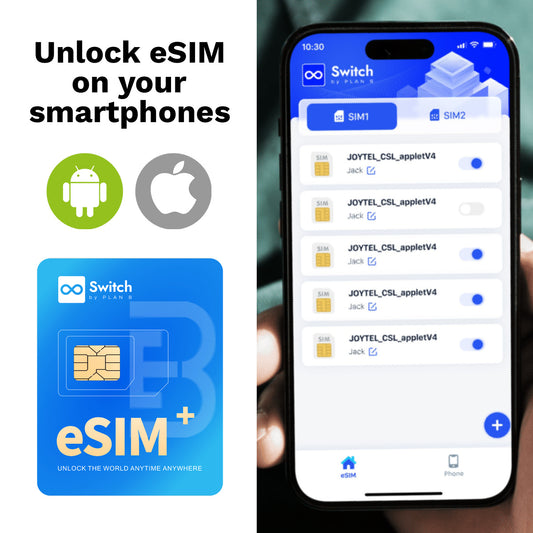
The card vendors say the same thing in their own documentation. 5ber's help pages: a single card holds up to 15 profiles, but "you can only activate one eSIM profile at a time." eSTK.me's product comparison repeats "Only the enabled profile is supported" across its range. Samsung Research's write-up of eSIM V3 notes that under V2, "most eSIM V2 devices in the market provide Dual-SIM functionality with a combination of eSIM and physical SIM card."
Is removable-plus-MEP conceptually impossible? No. Samsung filed a patent in November 2020 titled "Method and apparatus for handling profiles by considering a removable eUICC supporting multiple enabled profiles" — so the industry has thought about it as a distinct problem. But a patent application is not a shipping product, and I'm aware of no removable eUICC card on sale today that does it.
The real reason your phone shows one SIM
This is where the useful mental model lives, and it's documented by Google rather than inferred.
Android distinguishes physical slot indices from logical slot indices, and they need not match:
"A device which switches between dual-SIM and single-SIM mode may always have two physical slots, but in single-SIM mode it will have only one logical slot."
So the hardware can have two trays while the running configuration exposes one. And for a card without MEP, getPorts() "returns a list with one element." One port, one profile, one line.
Which produces these behaviours:
| Your phone | What you get with one adapter |
|---|---|
| Two SIM slots, both full-size | Adapter in slot 1 + physical SIM in slot 2 = two lines. This is device DSDS, not MEP. |
| Two adapters, two slots | Two lines — 5ber's own FAQ confirms "a total of two eSIM profiles." One active profile per card. |
| Hybrid tray (SIM 2 shares the microSD position) | Two lines or your memory card. Not both. Check your tray. |
| One SIM slot only | One line. The adapter occupies your only slot. |
| Phone with slot + native soldered eSIM | Adapter in the slot + a profile on the built-in eSIM should give two lines. Expected from the architecture; see the untested note below. |
The pattern: two lines require two slots, not two profiles.
Workarounds, honestly ranked
- Use both slots. The only reliable route. Adapter for the line you swap often (travel data), permanent SIM for the number people call.
- Two adapters. Works on dual-slot phones, doubles your profile pool, and both cards keep one active profile each.
- Adapter alongside a native eSIM, if your phone has both a tray and a soldered eUICC.
- Switch profiles instead of running both. Fast, but the disabled line is genuinely unreachable while disabled — not "on standby."
-
Buy a phone with MEP if simultaneous eSIM-only dual SIM is a hard requirement. That's Android 13+ and explicit OEM support. Do not assume; check
isMultipleEnabledProfilesSupported.
What won't help: more profiles, more storage on the card, a different app, or a firmware update to the card. None of these create a second baseband path.
What we've tested — and what we haven't
Filling this in honestly matters more than filling it in fast. Here's the protocol we're running; results will be published here with device names and build numbers.
For each device: (1) record OEM, model, Android/iOS version, and tray type; (2) query UiccCardInfo.isMultipleEnabledProfilesSupported and getPorts(); (3) insert adapter alone, confirm one line; (4) insert adapter plus physical SIM, confirm two registered subscriptions and that both can receive a call; (5) attempt to enable a second profile on the adapter and record the exact behaviour and any error; (6) repeat on a device that reports MEP support to confirm the contrast.
Currently unverified and marked as such: the adapter-plus-native-eSIM combination in the table above, and whether any device reporting MEP support behaves differently with an adapter than the architecture predicts. I'd rather leave those flagged than dress up a prediction as a result.
Correction note
An earlier draft of this article stated that GSMA SGP.21 v3.0 lists MEP support on a removable eUICC as "For Further Study." I could not locate that designation in the published specification and have removed it. SGP.21 does define the FFS convention and does distinguish removable from non-removable eUICC form factors, but I found no clause applying FFS to MEP on removable eUICCs. The limitation described here rests on MEP being optional in SGP.22 v3.0, on the device-side integration requirements Google documents, and on card vendors' own published behaviour.
Sources: GSMA SGP.22 v3.0 §2.12 · SGP.21 v3.0 / v3.1 definitions · AOSP "Multiple enabled profiles" · Android "Detect eSIMs and SIM cards" · UiccCardInfo API reference · Ludovic Rousseau, "CCID driver and Multiple Enabled Profiles," June 2024 · Samsung Research on eSIM V3 · 5ber and eSTK.me product documentation · patent CN116848867A
Learn more:
- SGP.21 RSP Architecture v3.0 (Future)
- SGP.21 RSP Architecture v3.1
- SGP.21 eSIM Consumer Architecture v2.5 (Current)
- https://www.gsma.com/solutions-and-impact/technologies/esim/wp-content/uploads/2021/07/SGP.21-2.3.pdf
- https://gsma.com/newsroom/wp-content/uploads/SGP.21-v1.01.pdf
- https://gsma.com/newsroom/wp-content/uploads/SGP.21_v2.0.pdf
- Android Open Source Project
- SGP.22 v3.0 - eSIM
- https://gsma.com/newsroom/wp-content/uploads/SGP.02_v3.1.pdf
- https://www.gsma.com/solutions-and-impact/technologies/esim/wp-content/uploads/2025/05/SGP.23-v1.16-Annex-K.pdf
- Android Open Source Project
- SGP.22 v3.0 - eSIM
- https://www.gsma.com/solutions-and-impact/technologies/esim/wp-content/uploads/2025/04/SGP.22-v2.6.1.pdf
- SGP.22 v2.7
- https://www.gsma.com/solutions-and-impact/technologies/esim/wp-content/uploads/2023/05/SGP.22-v2.5.pdf
- SGP.22 v2.6
- CCID driver and Multiple Enabled Profiles (MEP)
- https://www.gsma.com/solutions-and-impact/technologies/esim/wp-content/uploads/2021/07/SGP.22-v2.3.pdf?
- Samsung Research
- https://gsma.com/newsroom/wp-content/uploads/SGP.22_v1.2.pdf
- SGP.21 RSP Architecture v3.0 (Future)
- SGP.21 RSP Architecture v3.1
- SGP.21 eSIM Consumer Architecture v2.5 (Current)
- https://www.gsma.com/solutions-and-impact/technologies/esim/wp-content/uploads/2021/07/SGP.21-2.3.pdf
- Android Open Source Project
- https://www.gsma.com/solutions-and-impact/technologies/esim/wp-content/uploads/2024/04/SGP.31-v1.2.pdf
- https://gsma.com/newsroom/wp-content/uploads/SGP.21_v2.0.pdf
- LPA25 Code and SGP.21 Overview
- https://gsma.com/newsroom/wp-content/uploads/SGP.21-v1.01.pdf
- eSIM Consumer and IoT Specifications
- 5ber eSIM Card
- Android Open Source Project
- Android Open Source Project
- Method and apparatus for handling profiles by considering a removable EUICC supporting multiple enabled profiles
- About eUICC SIM profiles
- Android Open Source Project
- 5ber sim download profile error at es10b_authenticate_server · Issue #92 · estkme-group/lpac · GitHub
- ESTKme Product History
- Best eSIM adapter card for your phone, tablet, any mobile devices.
- Removable eUICCs...
- Android Developers
- Android Developers
- Detect eSIMs and SIM cards
- Session initiation protocol overview
- Android Open Source Project
- How can I check whether the Sim Card is available in an android device?
- TelephonyManager.UiccCardsInfo Property (Android.Telephony)
- UiccCardInfo Class (Android.Telephony)