
Best eSIM Management for Enterprises 2026: Switch Wins
Enterprises running mixed Android and iOS device fleets in 2026 don't need a carrier RSP contract to manage more than one eSIM profile per device. Physical eSIM adapter cards and reader-based provisioning cover most fleet use cases without opening a new carrier relationship.
- Switch Pro and Max Bulk Purchase lead esim management solutions for enterprises running mixed Android/iOS fleets in 2026.
- White Card eSIM Adapter fits OEM and white-label programs; the minimum order is 1,000 units.
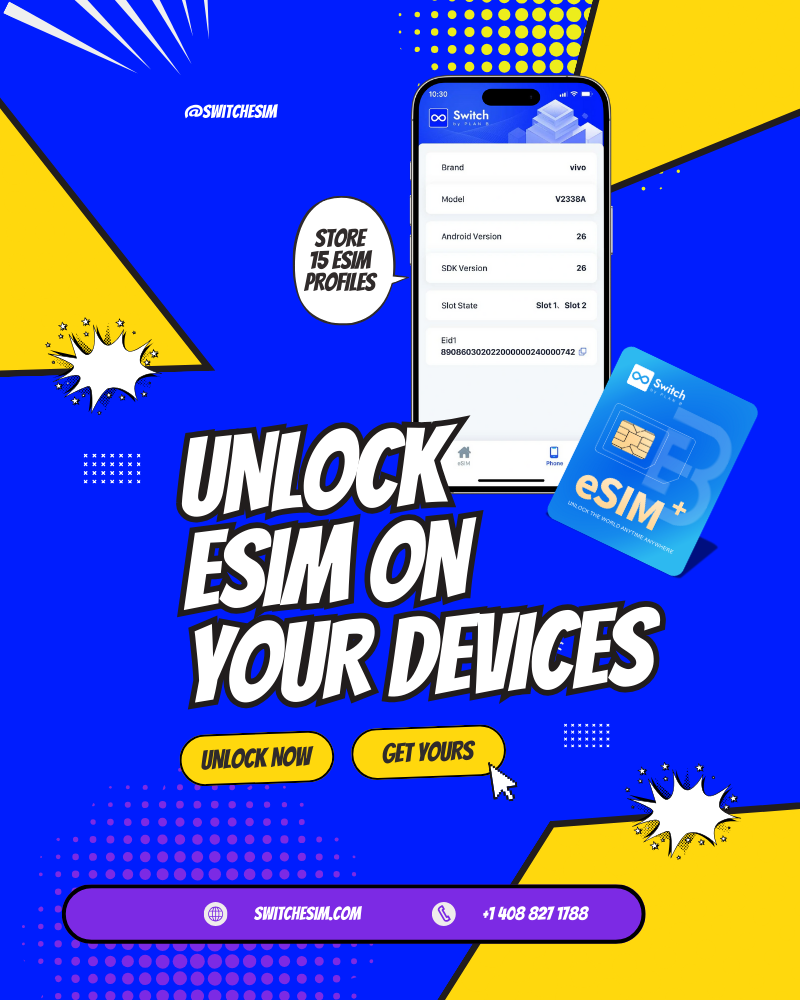
- Switch Pro and Switch Max each store up to 15 eSIM profiles per card without a carrier RSP contract.
- Open Source Bluetooth eSIM Card Reader provisions profiles without a phone, useful for routers and IoT devices.
- Switch eSIM Adapter Pro is the lowest-cost entry point for single-OS Android fleet rollouts.
Why this matters
IT teams issuing phones, routers and hotspots to field staff run into the same wall: most Android and iOS devices still tie eSIM management to one carrier's app, and swapping profiles across a fleet means physical SIM changes or waiting on a carrier portal. Enterprise eSIM management solutions built on physical adapter hardware skip that step — a card stores multiple profiles locally, and the host device treats it as a normal eSIM.
That distinction matters for three groups in 2026: companies running mixed Android/iOS device fleets, companies reselling connectivity hardware under their own brand, and teams operating routers, hotspots or IoT devices that have a physical SIM slot but no phone attached to them. Which pick wins depends on which of those three describes your rollout.
Best eSIM management solutions for enterprises in 2026 — the short list
Best overall: Switch eSIM Adapter Pro and Max — Bulk Purchase, for enterprises standardizing hardware across mixed Android and iOS device fleets in one procurement order. Best for OEM and white-label programs: White Card eSIM Adapter (unbranded eUICC, 1,000-unit minimum). Best budget entry point: Switch eSIM Adapter Pro (Android), the lowest per-unit cost in the Switch eSIM lineup for single-OS rollouts.
What makes the best enterprise eSIM management solution
- Profile capacity per card — how many eSIM profiles it stores at once without a re-flash
- Provisioning method — phone app, Bluetooth reader, or manual card swap
- OS and device coverage — Android-only, iOS-compatible, or reader-based and OS-agnostic
- Deployment format — retail units, bulk packs, or white-label/ODM
- Privacy model — local card control versus dependency on a carrier account
- Fit for non-phone hardware — routers, hotspots and IoT devices with a physical SIM slot
At a glance
| Solution | Best for | Standout feature | Key limitation |
|---|---|---|---|
| Switch Pro and Max — Bulk Purchase | Mixed Android/iOS fleet rollouts | One order covers both card types | Every target device still needs a compatible physical SIM slot |
| White Card eSIM Adapter | OEM / white-label enterprise programs | Unbranded eUICC, custom packaging | 1,000-unit minimum order |
| Switch eSIM Adapter Pro | Single-OS Android fleets | Stores up to 15 eSIM profiles | Android only, not usable in iPhones |
| Switch eSIM Adapter Max | Mixed-OS teams wanting one SKU | Same 15-profile capacity, works in compatible iPhones | iPhone compatibility depends on model, region and carrier lock |
| Open Source Bluetooth eSIM Card Reader | Router, hotspot and IoT fleets | Loads profiles on the card, no phone needed | Adds a separate piece of hardware to the kit |
| Pre-loaded eSIM Cards (iOS & Android) | Travel-team fleets needing instant connectivity | Ships with destination data already active | Fixed to the pre-loaded destination until reprovisioned |


1. Switch eSIM Adapter Pro and Max — Bulk Purchase: best for mixed Android/iOS fleet rollouts
The bulk pack combines Switch Pro and Switch Max cards in one procurement order, built for teams issuing both Android and compatible iOS devices in the same rollout.
Switch Pro and Max Bulk Purchase pros:
- Single order covers Android-only and mixed Android/iOS hardware
- Each card stores up to 15 eSIM profiles
- No separate white-label negotiation needed
Switch Pro and Max Bulk Purchase cons:
- Every target device still needs a compatible physical SIM slot
- Doesn't include the Bluetooth reader — Android profile management still runs through the Switch app
Best for: enterprises deploying both operating systems at once without a branded card program. Verdict: Buy for standardized mixed-OS rollouts in 2026.
2. White Card eSIM Adapter: best for OEM and white-label programs
White Card ships as a blank, unprinted eUICC card that a company brands and sells or deploys under its own name, with two variants and custom packaging available at the minimum order.
White Card pros:
- Ships unbranded for resale or internal branding
- Custom packaging design at the 1,000-unit MOQ
- Two card variants map to Pro-level and Max-level feature sets
White Card cons:
- 1,000-unit minimum excludes small pilot programs
- Underlying profile-management stack is still Switch's, not an independent platform
Best for: companies reselling eSIM hardware or running a fleet program under their own brand. Verdict: Buy once volume clears the 1,000-unit floor; otherwise stick with retail Switch Pro or Max cards.
3. Switch eSIM Adapter Pro: best for single-OS Android fleets
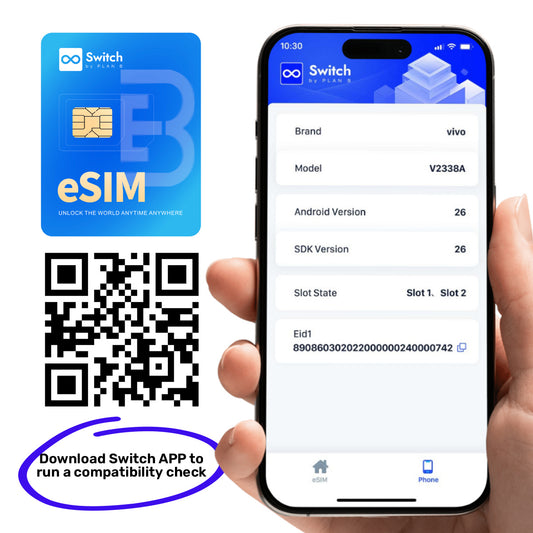
Switch Pro is a physical eSIM adapter for Android phones with a compatible SIM slot, managing up to 15 stored profiles through the Switch Android app.
Switch Pro pros:
- Lowest cost per unit in the Switch lineup
- 15-profile capacity covers a work line, a home line and multiple travel destinations on one card
- Profile switching runs through the Android app, no reader required
Switch Pro cons:
- Android only, does not work in iPhones
- Compatibility still depends on the specific Android model, regional variant and carrier-lock status
Best for: enterprises standardizing on Android-only device fleets. Verdict: Buy for single-OS Android rollouts.
4. Switch eSIM Adapter Max: best for mixed-OS teams wanting one SKU
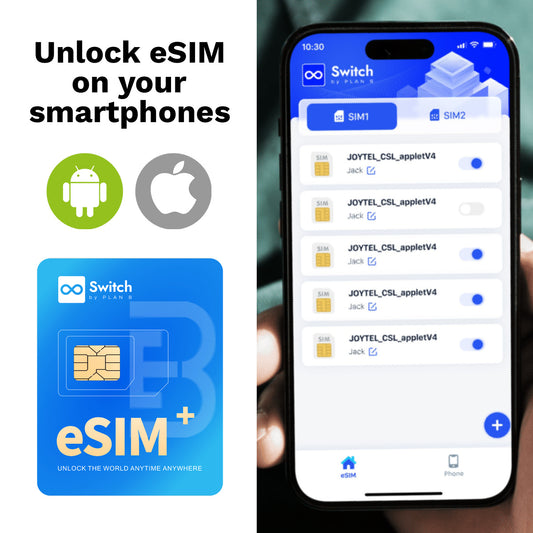
Switch Max is a SIM-sized card that adds eSIM profile storage to phones with a compatible physical SIM slot, including select iPhones, holding up to 15 profiles.
Switch Max pros:
- One SKU covers Android and iOS-compatible devices
- Same 15-profile capacity as Switch Pro
- Cuts the number of SKUs an IT team tracks across a mixed fleet
Switch Max cons:
- iPhone compatibility depends on model, regional variant, iOS version and carrier-lock status — not every iPhone in a fleet qualifies
- Profile management on iPhone differs from Android; verify device-specific setup before a full rollout
Best for: mixed Android/iOS teams that want one hardware SKU instead of two. Verdict: Buy, after confirming the iPhone models in the fleet meet the compatibility checklist.
5. Open Source Bluetooth eSIM Card Reader: best for router, hotspot and IoT fleets
The Bluetooth eSIM card reader loads and manages profiles directly on a Switch adapter card without routing through a phone — insert the card, connect the reader, manage profiles from there.
Bluetooth reader pros:
- Provisions profiles for routers, hotspots and IoT devices with a physical SIM slot but no phone-based app
- Removes dependency on a specific phone OS or app version
- Open-source hardware, easier for an enterprise to audit the provisioning path
Bluetooth reader cons:
- Adds a separate piece of hardware to the deployment kit
- The target device still needs to accept a physical SIM/eSIM adapter card
Best for: fleets of routers, hotspots or IoT devices with a SIM slot and no dedicated phone. Verdict: Buy for non-phone deployments.
6. Pre-loaded eSIM Cards for iOS & Android: best for travel-team fleets
These cards ship pre-loaded with a destination data plan before deployment, so a travel team gets working connectivity on arrival instead of provisioning profiles after landing.
Pre-loaded cards pros:
- Cuts setup time for staff traveling internationally
- Works with both Android (Pro-based) and iOS-compatible (Max-based) hardware
- Fewer help-desk tickets during a trip
Pre-loaded cards cons:
- Data plan is fixed to what's pre-loaded; swapping destinations still requires profile management afterward
- Suited to short trips, not indefinite fixed fleets
Best for: travel teams and field staff who need connectivity working immediately after landing. Verdict: Buy for short-cycle travel; skip for long-term fixed deployments.
How we ranked
Each solution above is scored against the six criteria listed earlier: profile capacity, provisioning method, OS coverage, deployment format, privacy model, and fit for non-phone hardware. The bulk pack and White Card score highest on deployment format for scale; Switch Pro and Switch Max score highest on cost-per-device and capacity; the Bluetooth reader wins on non-phone fit; pre-loaded cards win on setup speed for travel.
Which enterprise eSIM management solution should you choose?
If the fleet mixes Android and iOS devices and you're buying more than a handful of units in 2026, start with Switch Pro and Max Bulk Purchase. If the goal is reselling hardware or running a branded internal program, the White Card eSIM Adapter is the only option built for that, once volume clears 1,000 units. Single-OS Android teams on a tight budget default to Switch eSIM Adapter Pro. Router, hotspot and IoT fleets without a phone in the loop need the Open Source Bluetooth eSIM Card Reader regardless of which card they pair it with.
FAQ
What is the best eSIM management solution for enterprises in 2026?
For mixed Android and iOS device fleets, Switch Pro and Max Bulk Purchase is the strongest fit in 2026 because it covers both operating systems in one order. Single-OS Android fleets do better with Switch eSIM Adapter Pro alone.
Can enterprises manage eSIM profiles without native carrier eSIM support?
Yes. Physical eSIM adapter cards like Switch Pro and Switch Max store up to 15 profiles locally and let a compatible device switch between them without a carrier's own eSIM management app.
How many eSIM profiles can one Switch Pro or Switch Max card hold?
Both cards store up to 15 eSIM profiles at once, enough for a work line, a home line and several travel or project destinations on a single card.
Is there a white-label eSIM adapter option for enterprise branding?
Yes. The White Card eSIM Adapter ships as a blank, unprinted eUICC card that a company brands and sells under its own name, with a 1,000-unit minimum order.
Does the Bluetooth eSIM reader work without a phone?
Yes. The Open Source Bluetooth eSIM Card Reader loads and manages profiles directly on the card, which makes it useful for routers, hotspots and IoT devices that have no dedicated phone.
What's the difference between Switch Pro and Switch Max for enterprise fleets?
Switch Pro works only with Android phones that have a compatible physical SIM slot. Switch Max adds compatibility with select iPhones, so mixed-OS teams can standardize on one SKU.
What is the minimum order quantity for white-label eSIM cards?
The White Card eSIM Adapter program requires a 1,000-unit minimum order, with custom packaging available at that volume.
Can pre-loaded eSIM cards ship with destination data already active?
Yes. Pre-loaded eSIM Cards for iOS & Android ship with a destination data plan already provisioned, so a travel team has working connectivity on arrival without a setup step.
One last thing
The real dividing line in this list isn't Android versus iOS — it's the 1,000-unit White Card minimum. Anything under that volume, buy retail Switch Pro or Switch Max cards and skip the ODM conversation entirely; anything over it, White Card is the only option built for a branded rollout in 2026.